The Real Cost of a Manual Handling Injury in Electromechanical Assembly
Published by Vertical Lift Machines | September 2026 | Category: WHS / Manual Handling
A claim is not the cost. It is the invoice for a cost the task was charging you all along.
The motor weighs 45 kilograms. By the time the claim it causes is closed, it will be the cheapest thing involved.
Electromechanical plants are full of parts like it. The wound stator the size of a spare tyre and more than twice the weight. The compressor that fits between two hands and pulls a back out through sheer density. The gearmotor with no grip points that gets carried against the chest because there is no other way to hold it. None of them look like a lifting problem. All of them are, because copper and steel pack more weight into less space than almost anything else made in a factory.
So the lift never gets engineered. It looks like a carry, it gets treated like a carry, and it runs two hundred times a shift until the day it does not. Then the costs start arriving, and they do not stop at the claim.
What one injury actually costs
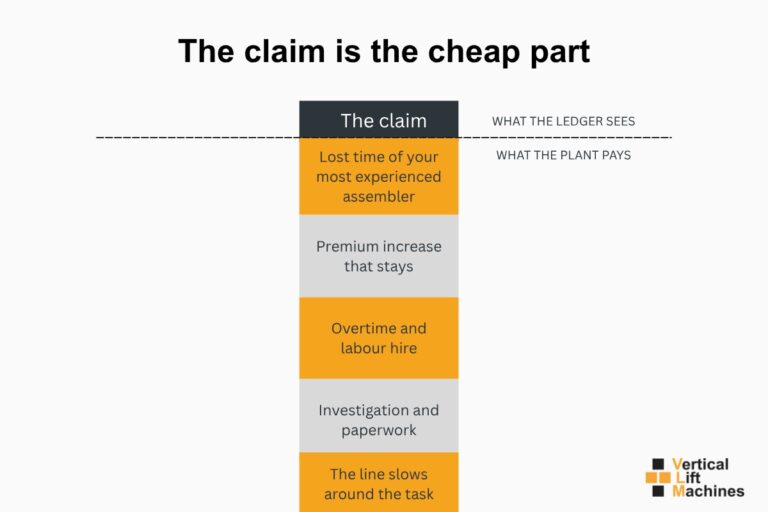
Talk to any plant that has been through a serious lifting injury and the claim itself is rarely what they remember. It is the stack that came with it.
There is the claim. Then the lost time, and it is almost never a spare pair of hands that goes down; it is the experienced assembler whose output the bench was quietly built around. There is the premium that moves at renewal and stays moved for years. The overtime and labour hire covering the gap, usually at a higher rate than the wages they replace. The investigation, the reporting, the corrective-action paperwork, all of it landing on the same supervisors who are already covering the roster hole.
And there is the quiet cost that never gets a line in any ledger: the rest of the team is now wary of the same task. The lift slows down. The informal two-person rule appears, which means two people are now tied up on a job that officially needs one. Throughput pays for the injury long after the claim is closed.
It was never bad luck
The instinct after an injury is to treat it as an event: something that happened, on a day, to a person. On a dense-load task that framing is wrong, and it is expensive.
A hazardous manual task is defined by force, posture, repetition and duration. A compact 40 kilogram part carried close to the body, placed precisely, hundreds of times a shift, scores on every factor at once, and it does so on every cycle, not just the one that ends in a claim. The exposure was on your books the whole time. The injury is simply the moment it converts into an invoice.
That is also why the fix is not another toolbox talk. We covered in an earlier article why a risk assessment on its own is not enough – admin controls change the paperwork around the lift, and PPE changes what the operator wears during it. Neither changes the lift. On a task that is dense, precise and repeated, only an engineering control does.
The task runs two hundred times a shift. The injury was never bad luck. It was scheduled.
Cost the task before it costs you
You do not need an incident to put a number on the exposure. You need one walk of the line and three numbers per task: the load weight as the part is actually handled, the movement required, described as verbs and angles, and the lifts or placements per shift.
Mark every station where a part is dense, carried close to the body, placed precisely, or quietly handled by two people. Those marks are your shortlist. Then, for the worst one, write the stack next to it: what a claim on this task would cost, whose lost time it would be, what the backfill looks like, what it does to the line’s pace. Most plants have never written that number down. It is usually the most persuasive document the site’s WHS case has ever produced, and it speaks the language your obligations are written in: the Safe Work Australia guidance on hazardous manual tasks is built around identifying force, posture, repetition and duration in the task, before harm occurs, not after.
Bring the operators on the walk. The spec sheet says what the part weighs; the person who moves it two hundred times a shift knows which lift they feel at knock-off, which placement gets less square by mid-afternoon, and which job quietly became a two-person task without anyone writing it down. Their answers are the difference between a paper exercise and a shortlist your floor already agrees with. They are also the beginning of operator acceptance, which will decide later whether any control you install actually gets used.
Be honest about the recurring costs while you write the stack. A premium does not move once; it moves at renewal and takes years of clean history to come back. Backfill labour is bought at market rates on short notice, not at the wages it replaces. And the slowdown around the task rarely ends when the injured person returns, because the informal two-person rule tends to stay. None of this needs to be forecast to the dollar. Written next to one task in plain language, it is already the clearest picture of exposure most sites have ever had.
What removes the exposure: an engineering control
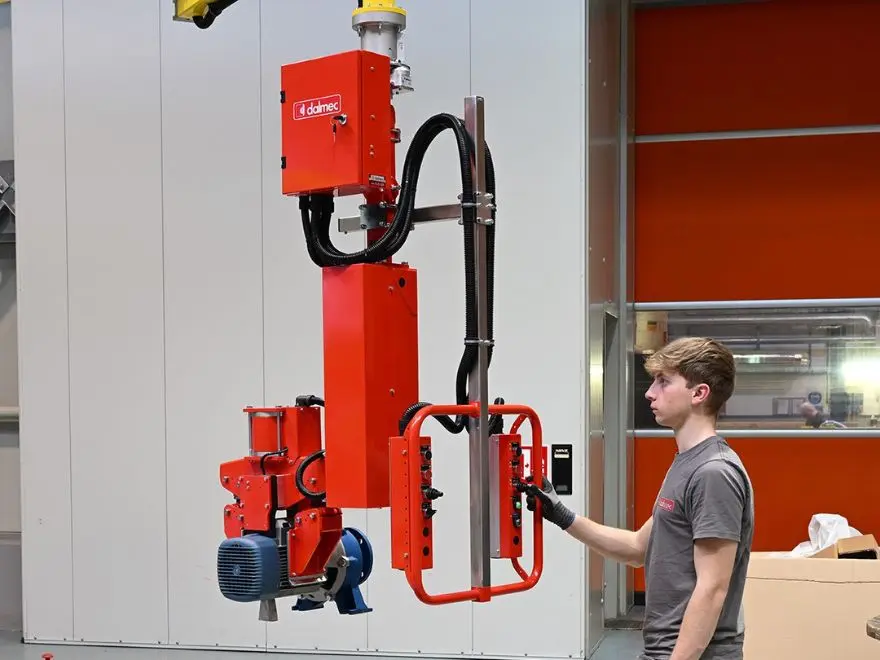
Once the stack is written down, the hierarchy of control says what to do about it. A pneumatic industrial manipulator is an engineering control for exactly this class of task: the machine carries the full weight of the part, and the operator guides it with one hand. Grip strength, fatigue and posture stop being what holds the load in the air. That is what our Dalmec industrial manipulators do on electromechanical floors every shift.
The tooling is engineered to the part, because electromechanical parts resist standard slings and hooks. Expanding bore grippers pick a wound stator from the inside without touching a winding. Shaft clamps with pneumatic rotation hold a rotor rigid for a zero-contact insertion. Shaped jaws take gearmotors and housings on and off test benches all shift. Vacuum tooling lifts finished panels and appliances square into cartons. The applications across the electromechanical sector cover the winding line, rotor insertion, the test bench, coupling and end-of-line packing: the same five stations where the cost stack builds.
The result reads simply on the floor. The lift that used to need two people and a held breath becomes a one-hand placement. The two-hundredth cycle of the shift is placed exactly like the first. And the exposure you costed in the walk comes off the books for that task, documented as an engineering control against it.
The control is also documentable, which matters as much as the mechanics. A manipulator sits at the engineering level of the hierarchy of control and can be recorded as such in the risk register against the specific task, with the residual risks addressed in the machine design: the load is held if air supply is lost, descent speed is limited, and the grip stays closed without power. That is the difference between telling an inspector the task is being managed and showing them the lift no longer exists in the form that produced the exposure.
Solved Before, at Scale
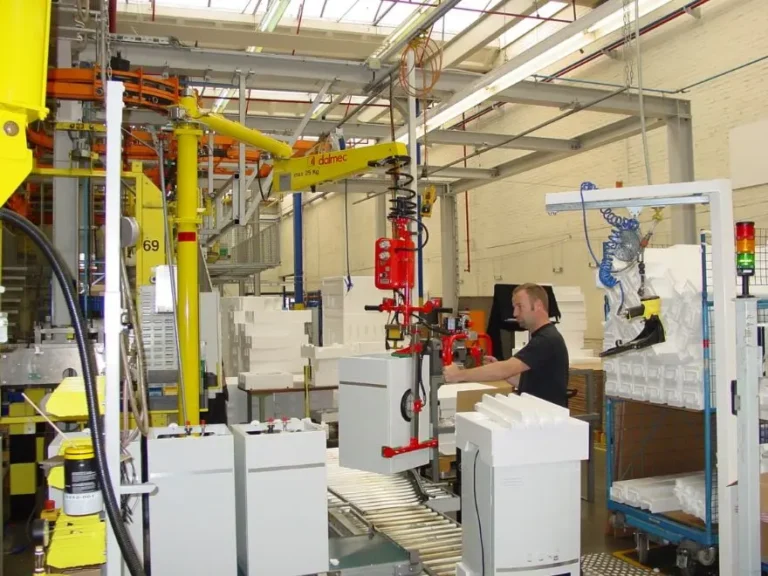
Dense electromechanical loads are not a new problem for this equipment. Dalmec has been building industrial manipulators since 1966, and motor and appliance assembly is one of the founding application families. There are over 70,000 Dalmec manipulators installed worldwide, and more than 650 across Australia and New Zealand, many of them doing precisely the lifts described in this article, every shift, for decades of service life.
When we assess an electromechanical handling task we are pattern-matching against installations that already run. The stator has been gripped by its bore before. The rotor has been turned in mid-air before. The finished unit has been packed square before. That precedent is what de-risks your install.
There is a local layer to that precedent too. Every unit is a consultative build: the site survey measures your real part and your real movement, the tooling is engineered to the part family rather than adjusted from a catalogue, and the balancing is tuned at commissioning until the load floats and the operators are steering rather than carrying. The survey, install, commissioning and ongoing service all happen here, which is why the installed base stays installed.
If the number surprises you
Not every task justifies a manipulator, and we will tell you when yours does not. A dense lift that happens twice a week is a different conversation from one that happens two hundred times a shift. But if writing the stack next to one task put a number on an exposure your own crew already talks about, the next step costs you three details, not a capital commitment: load weight as the part is actually handled, the movement required as verbs and angles, and lifts per shift. With those three we will tell you whether an engineering control is available for the task, what it looks like, and an indicative cost. It is the same three-detail assessment that turns a costed task into a business case your finance meeting can approve.
Start With Three Details
Load weight. Movement required. Lifts or placements per shift.
That is all we need to tell you whether an engineering solution makes sense for your floor.
dalmec.au | 1300 886 277
Vertical Lift Machines Pty Ltd is the authorised Dalmec distributor for Australia and New Zealand. Dalmec pneumatic manipulators are installed across 650+ sites in Australia and New Zealand, including motor, drive, switchgear and appliance manufacturers across the electromechanical sector.