
Industrial Manipulator or Cable Balancer? A Selection Guide
- Home
- Industrial Manipulators and Lift Assist Devices, Dalmec Australia
How to Choose the Right System
Choosing between a rigid-arm industrial manipulator and a cable balancer comes down to three things: the weight of the load, the movement the task requires, and how often the lift is repeated each shift. A rigid-arm manipulator suits heavy, off-centre or irregular loads that must be tilted, rotated or precisely placed, handling from 10kg up to 1,500kg. A cable balancer suits lighter, consistently shaped loads on a simple up-and-down path, at a lower capital cost. Both are purely pneumatic, both are custom engineered by Dalmec around your product and layout, and both are supplied, installed and serviced across Australia and New Zealand by VLM, Dalmec’s exclusive distributor.
Over 650 Dalmec systems installed across Australian and New Zealand workplaces.
FAQ
How do I know whether my task needs a manipulator or a balancer?
Describe three things: the load (weight, shape, whether its centre of gravity is offset), the motion (straight vertical lift, or tilting, rotating and placing), and the frequency (lifts per shift). Vertical-only handling of consistent loads under about 90kg usually suits a cable balancer. Anything heavier, off-centre, or needing multi-axis movement calls for a rigid-arm manipulator. VLM assesses this free of charge from photos or a short site visit.
What is the difference between an industrial manipulator and a crane or hoist?
A crane or hoist only moves a load vertically and still leaves the operator wrestling with swing, rotation and positioning. A Dalmec manipulator holds the load continuously balanced in three dimensions, so one operator can lift, tilt, rotate and place it precisely with almost no physical effort, and at production line speed.
How are Dalmec systems mounted?
Three ways: a fixed floor column, an overhead fixed mount, or an overhead trolley running on rails for coverage along a line. The right mounting depends on your working radius, floor space and building structure. Every installation is engineered around the layout of your facility.
Can one machine handle more than one product?
Often, yes. Dalmec engineers custom gripping tools, and where a workstation handles a family of similar products the tooling can be designed to grip the range, or made quick-change so one manipulator serves several tasks.
INDUSTRIAL MANIPULATOR OR CABLE BALANCER?
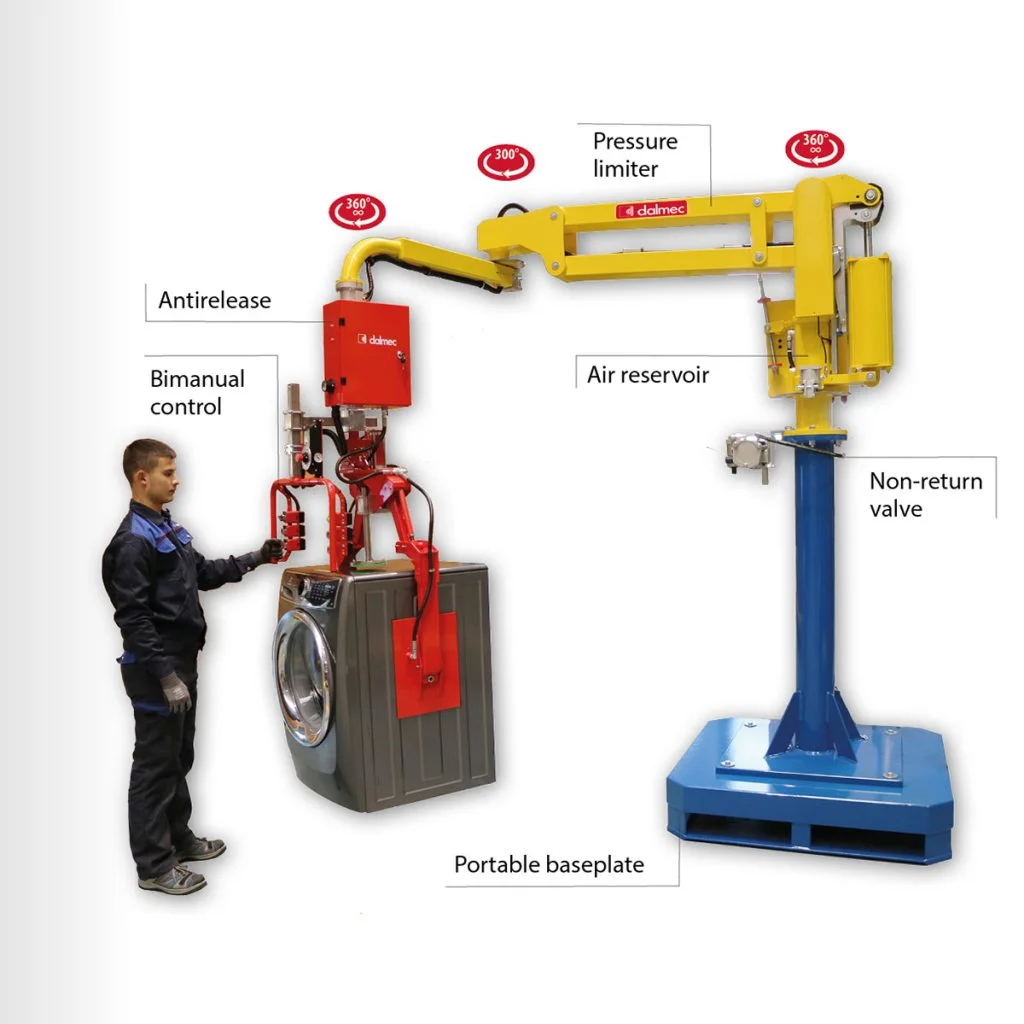
Industrial manipulator
An industrial manipulator is a machine with a rigid steel manipulator arm that allow complex pneumatic tilts and rotations — even when the product being moved is handled outside it’s barycenter.
An operator leads the manipulator, allowing for easy and precise movement of the manipulator to lift, lower and otherwise transport a product.
Industrial manipulators are frequently used when:
- A product is too heavy for a person to move manually
- A product must be moved to a location that is not easily or quickly accessible for a person to reach, like a very tall shelf
- When a worker will be put at risk for injury if they move a product manually
- When a person will quickly fatigue from moving products manually
- A high volume of product must be moved in a timely fashion
- The handiness for the manipulator to move products outside of its barycenter becomes more appreciated as you start working with heavier loads or products that are not regular- shaped, as other types of machines (including balancers with cables) are not so efficient if not with light or standard shaped products.
Cable Balancer
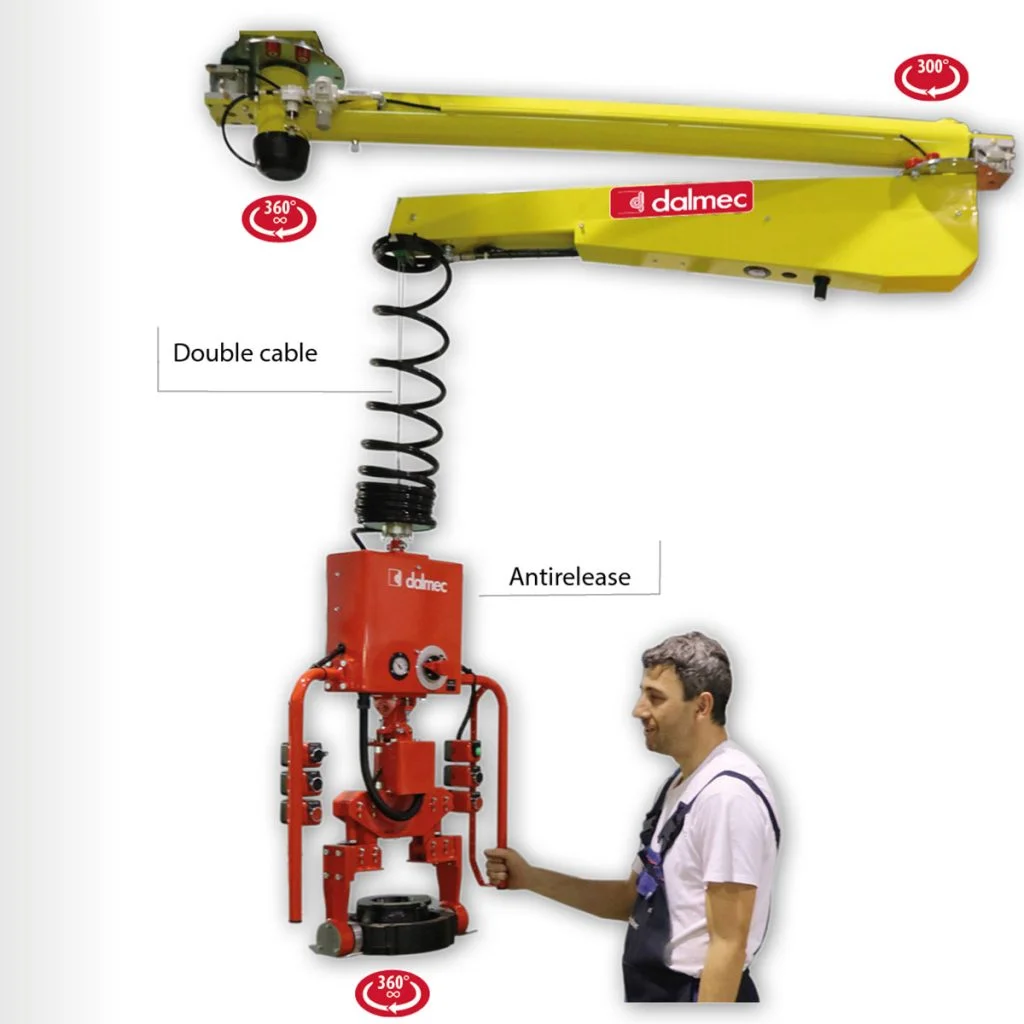
Cable balancers, are best for moving lighter objects that are in standard shapes.
Cable balancers use steel or nylon cables to move products up or down.
On cable balancers built by Dalmec, use a system of cables and pulleys wrap around pulleys paired with a pneumatic cylinder. As those cylinders stretch or withdraw, the cables wrap and move vertically up and down the product.
Some small manipulation of product can happen through the tooling even if the product’s barycenter does not coincide with its center of mass
Industries That Rely on Manipulators and Balancers
Manipulators and cable balancers are used in a wide range of industries across the globe to help companies move with efficiency and safety.
Some of the many industries that rely on these machines include:
WHICH TYPE OF MANIPULATOR SHOULD YOU USE IN YOUR WORK ENVIRONMENT?
If you aren’t sure if a cable balancer or a manipulator would be right for your work environment, consider the following factors:
- The weight of the product you need to move
- The size and shape of the product you need to move
- The trajectory of the movement you need the machine to perform
- Lighter weight products (usually those less than about 90kg) and standard shapes that only need to be moved up and down are good candidates for an arm with cables.
- Heavier products (up to 1,500 kg), products with odd shapes and products that need to be moved and repositioned both horizontally and vertically are best suited for manipulators.