There is a pattern we see on almost every food and beverage production floor we visit.
The SWMS is current. The team has been trained. Rotation schedules are in place. Someone rotates off the heavy task every two hours.
The paperwork is clean. The risk is still there.
By 2pm, throughput is down. By 3pm, the operators who have been on the line since 7am are slower, less precise, and carrying a cumulative physical load that no rotation schedule reversed. The task is still happening. The body is still absorbing it.
This is not a workforce problem. It is a task design problem. And the WHS Act treats it differently to how most food manufacturers have been managing it.
What the WHS Act Actually Requires
The WHS Act does not ask whether each lift was within safe weight limits. It does not ask whether your operators were trained or whether your SWMS was current.
It asks whether you took all reasonably practicable steps to eliminate or minimise the risk.
“Reasonably practicable” is not a high bar to clear. For a task done hundreds of times per shift on a food production line, an engineering solution that removes the physical demand is almost always going to be reasonably practicable. The cost of the control is measured against the probability of harm, the severity of that harm, and the benefit of the control. Purchase price alone is not the measure.
When WorkSafe reviews a manual handling claim, or when your insurer asks what controls were in place for a known risk, the question is not “did you have a procedure?” It is “did you apply the highest practicable control on the hierarchy?” Our Dalmec solutions for food and beverage manufacturing page covers what that looks like in practice across common food production tasks.
The Hierarchy of Controls: Where Your Rotation Schedule Sits
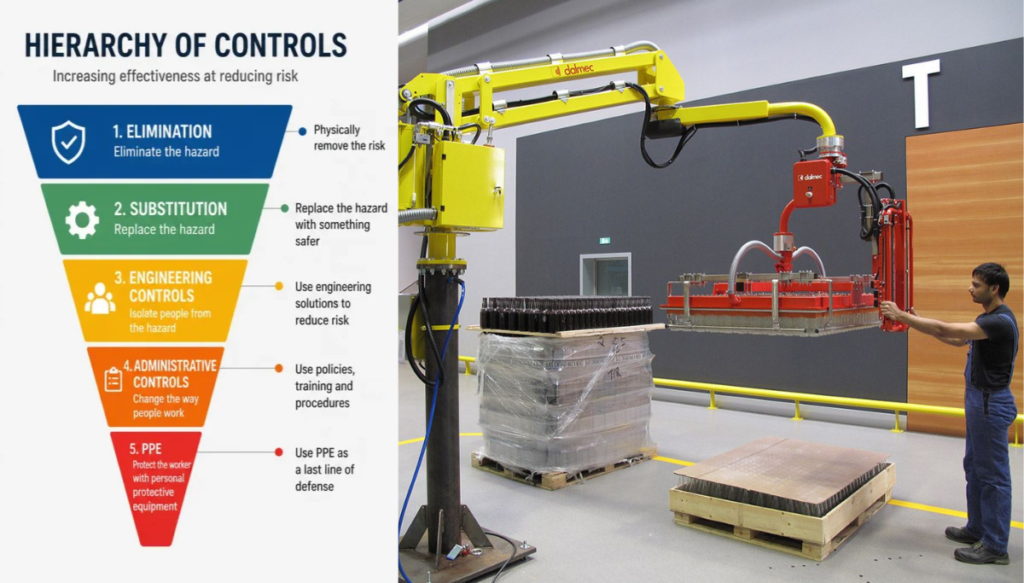
The hierarchy of controls is not a suggestion. Under the WHS Act, it is the required framework for managing risk. From top to bottom:
- Elimination
- Substitution
- Engineering controls
- Administrative controls
- PPE
Rotation schedules sit at level four. So does safe lifting training. So does a two-person lift requirement in your SWMS.
Administrative controls manage how people interact with the hazard. They do not change what the task demands physically. They do not remove the hazard. They rely on consistent human behaviour across every shift, every day. Including the days when someone calls in sick and the rotation breaks down.
An engineering control sits at level three. It changes the task itself. The physical demand is removed at the source, regardless of who is on shift, how long they have been on the line, or whether the rotation schedule ran on time.
Under the WHS Act, if an engineering control is reasonably practicable, an administrative control is not sufficient on its own. It is not a matter of preference. It is a compliance gap.
What It Costs to Carry the Risk
Most operations managers underestimate the cost of a single manual handling claim. The workers compensation payment is the visible number. The real cost is larger.
A serious musculoskeletal injury in food manufacturing typically involves:
- Direct costs: Workers compensation claim, medical treatment, rehabilitation
- Replacement labour: Backfilling a trained production operator, often with overtime or a labour hire rate
- Throughput loss: The line running at reduced capacity during recovery and retraining periods
- WorkCover premium movement: A significant claim affects your premium for three to five years
- Management time: Incident investigation, SafeWork notification, legal review, insurer liaison
Safe Work Australia data consistently places body stressing injuries among the top causes of serious workers compensation claims in Australian manufacturing. The average cost of a serious claim, across direct and indirect costs, routinely exceeds the cost of an engineering control for the task that caused it.
The question is not whether you can afford to install an engineering control. It is whether you can afford not to, and whether the WHS Act gives you the option to wait for a claim before acting. Our Manual Handling Risk Calculator can help you put a number on your current exposure before that conversation becomes necessary.
What an Engineering Control Looks Like in Practice
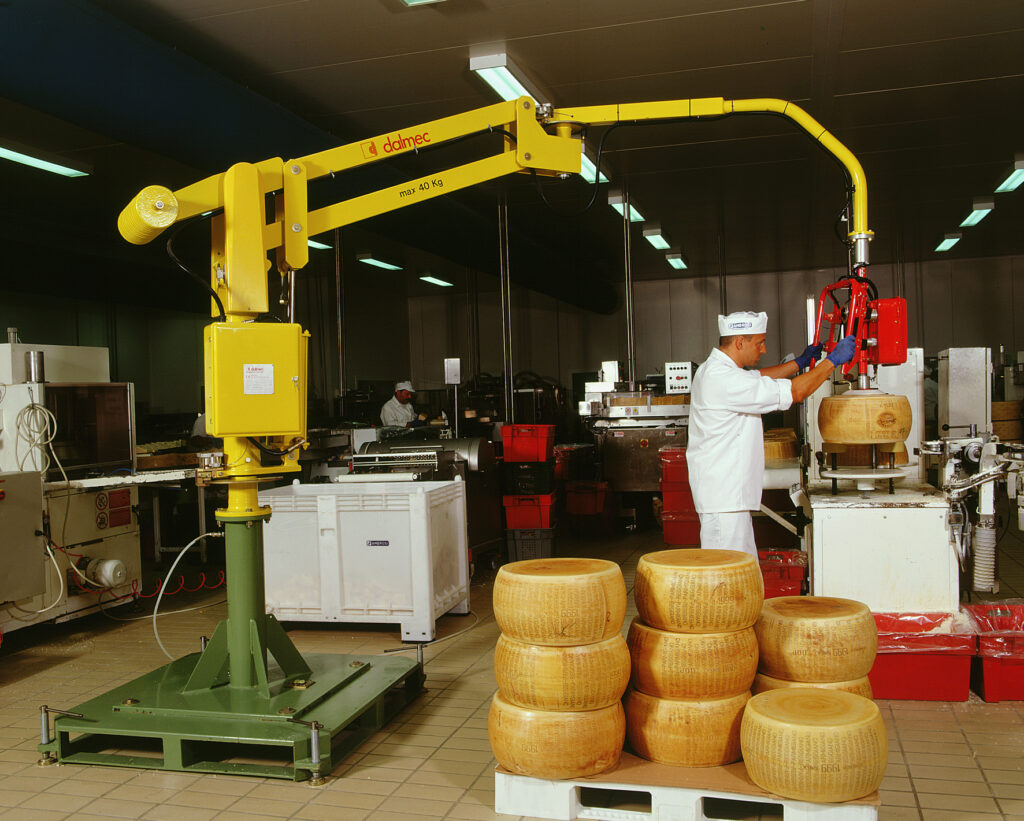
Dalmec industrial manipulators are not lifting aids in the traditional sense. They are custom-engineered systems that carry the full weight of a load — leaving the operator to guide it into position with minimal physical effort.
The operator is no longer lifting. They are guiding.
This is not a subtle difference. It is a fundamental redesign of the task itself.
Dalmec systems are purely pneumatic — no electric motors, no hydraulics, no electronic drive systems. They are custom-engineered for each specific load, motion, and workspace. There is no off-the-shelf unit. Every system is built for the exact task it will perform, every shift, for the life of the installation.
The Business Case, Before a Claim Forces the Conversation
The food and beverage manufacturers who engage us on manual handling are almost never coming off a claim. They are WHS managers and operations leaders who have seen what happens elsewhere, or who have done the maths on what the task is costing them in throughput and fatigue. They acted before a claim made the decision for them.
The conversation is always the same: load weight, motion, lifts per shift. From that, we can tell you whether a Dalmec solution is viable for the specific task, what it would cost, and what the likely payback period is against the risk you are currently carrying.
For most high-repetition food production tasks, the numbers stack up. Typically within 12 to 18 months.
If your operation has a manual handling task running all shift with no documented engineering control, send us the load weight, the motion, and how many times per shift it happens. We will give you a straight answer.
Frequently Asked Questions
Is a rotation schedule enough to satisfy WHS manual handling obligations in food manufacturing?
No. A rotation schedule is an administrative control — it sits at level four of the hierarchy of controls under the WHS Act. Administrative controls manage how people interact with a hazard; they do not remove the hazard. Where an engineering control is reasonably practicable, the Act requires you to apply it. For high-repetition tasks in food manufacturing, an engineering control is almost always reasonably practicable.
What is an engineering control for manual handling?
An engineering control removes the physical demand from the task at the source. A Dalmec pneumatic manipulator is an engineering control: it carries the weight of the load while the operator guides it into position. The repetitive lifting demand is eliminated, regardless of shift length, operator rotation, or staffing levels. It is documented in the WHS file as a control, not a procedure.
How do I know if a Dalmec manipulator is suitable for my production task?
The three things we need to assess a task are: load weight, motion description (lift, rotate, tilt, transfer, feed into machine etc.), and how many times per shift the task is performed. Send those three details and we will tell you whether an engineered solution makes sense for your specific application.
Vertical Lift Machines is the authorised Australian and New Zealand distributor for Dalmec industrial manipulators. With 650+ units installed across Australia and New Zealand, we work with food and beverage manufacturers to engineer the lift out of high-repetition production tasks.