Industrial Manipulators and Lift Assist Devices, Dalmec Australia
What is an Industrial Manipulator?
An industrial manipulator is a pneumatic lift-assist device that allows a single operator to handle heavy, awkward, or repetitive loads with virtually no physical effort. Powered entirely by compressed air, it holds any load in a continuously balanced state so the operator can guide the load through lifting, lowering, rotation, and precise placement without bearing its weight.
Unlike a crane or hoist that only moves loads vertically, a Dalmec manipulator provides full three-dimensional control. And unlike off-the-shelf lifting equipment, every Dalmec system is custom-engineered around the specific task, the load, the grip, the motion, and the workplace layout, making it a documented engineering control under Australia’s Work Health and Safety Act hierarchy of controls.
Over 650 Dalmec systems installed across Australian and New Zealand workplaces.
FAQ
How does a pneumatic industrial manipulator work?
Every Dalmec manipulator runs on compressed air only. The system continuously adjusts air pressure to counterbalance the exact weight of the load, keeping it suspended at whatever height the operator sets it. At that point the operator is no longer carrying anything. They are guiding. The
physical demand of lifting is removed from the task entirely, which means consistent performance across a full shift with no fatigue accumulation. Because there are no electrical motors or control electronics in the arm itself, Dalmec manipulators perform reliably in demanding conditions including wash-down areas, paint booths, dusty fabrication environments, and ATEX-rated hazardous zones where electrical components create risk.
What are the main benefits of using an industrial manipulator?
The primary benefit is a significant reduction in workplace injury risk. By removing the physical demand of manual handling, Dalmec manipulators help prevent Musculoskeletal Disorders (MSDs) and Repetitive Strain Injuries (RSI), the leading categories of serious workers’ compensation claims in Australian workplaces. Beyond safety, they improve operational efficiency by allowing a single operator to handle loads that would otherwise require two people or a slower crane or hoist system. Consistent output, reduced fatigue, and improved operator retention are the downstream operational gains.
Can industrial manipulators be customised for specific tasks?
Yes. Unlike standard lifting equipment, the most effective industrial manipulators are bespoke. At Dalmec, we engineer custom gripping tools (end-effectors) tailored to the specific geometry of the product, whether it is a vehicle component, a roll of material, a heavy carton, or a chemical drum. This ensures the load is held securely and can be manoeuvred into the exact orientation required for the next stage of production or handling.
Do Dalmec manipulators comply with Australian workplace safety regulations?
Yes. All Dalmec installations in Australia are designed to meet and exceed applicable workplace safety requirements. Our systems are engineered as engineering controls, the highest level of control in the hierarchy of controls under the Work Health and Safety Act 2011 and the Model WHS Regulations (hazardous manual tasks). Each installation is documented to support a PCBU’s duty to eliminate or minimise manual handling risk so far as is reasonably practicable. Dalmec systems carry EC/CE certification to European Machinery Directive standards, and VLM holds Australian compliance certification for local installations.
Does Dalmec have nationwide installation and service support in Australia?
Yes. VLM, the exclusive Australian and New Zealand distributor for Dalmec, has installed over 650 Dalmec manipulators in workplaces across every state and territory. Our experienced team coordinates site assessment, custom engineering, installation, commissioning, and after-sales service nationally. Whether your facility is in Perth, Sydney, Melbourne, Brisbane, Adelaide, or regional Australia, we provide local support backed by Dalmec’s global engineering network.
How does a custom material handling solution improve overall productivity?
By replacing manual lifting with a Dalmec engineered manipulator or balancer, businesses reduce operator fatigue, prevent injuries, and maintain consistent production speeds across a full shift. Unlike a human operator whose output degrades with fatigue, a Dalmec system delivers the same handling performance at the start of the shift as the end. These improvements lead directly to higher throughput, fewer delays, reduced rework from handling errors, and measurable cost savings over the system’s 20+ year service life.
Eliminate Manual Handling Risk
Powerful industrial manipulators, lift assist devices, and material handlers designed to meet the highest safety standards. Dalmec engineers will work closely with you to custom build to the exact specifications for your job.
Engineered for Your Exact Task
Every sector faces material handling issues, but Dalmec can assist. From food and pharmaceuticals to textiles and packaging, Dalmec’s lift assist devices and pneumatic manipulators seamlessly integrate into a company’s infrastructure, addressing handling requirements and reducing costs while enhancing an organization’s structure.
650+ Installations Across Australia & New Zealand
It’s highly likely that Dalmec has expertly addressed your material handling challenges in various parts of the world. With over five decades of experience and a dedication to innovation, we’ve consistently provided top-notch solutions that guarantee the smooth flow of materials in a multitude of industries.
About Dalmec
Dalmec has been building industrial manipulators since 1963. Every system is designed and manufactured at its facility in Cles, Italy, by engineers who work exclusively in this field. That depth of focus over six decades is why Dalmec operates across more than 40 countries, with tens of thousands of installations running in industrial facilities worldwide.
In Australia and New Zealand, every Dalmec manipulator is supplied, installed, and supported by VLM, the exclusive local distributor. More than 650 systems have been installed across Australian and New Zealand workplaces, every state and territory covered, with local expertise behind every one.
Engineered for Every Load. Built for Australian Industry.
The Dalmec range covers 11 manipulator models spanning 10kg to 1,500kg capacity. Available in floor, overhead, and overhead trolley-mounted configurations, every model can be positioned to suit the layout of your facility.
Every model is supplied with custom tooling designed around the specific product being handled, from suction cups for sheet glass and cartons to mechanical grippers for drums, pails, and structural components.
All Dalmec systems are certified to EC Machinery Directive 2006/42/CE and manufactured under EN ISO 9001:2008 quality management standards. For businesses managing WHS obligations, every installation is a documented engineering control, sitting above administrative controls in the hierarchy of controls and defensible under the WHS Act.
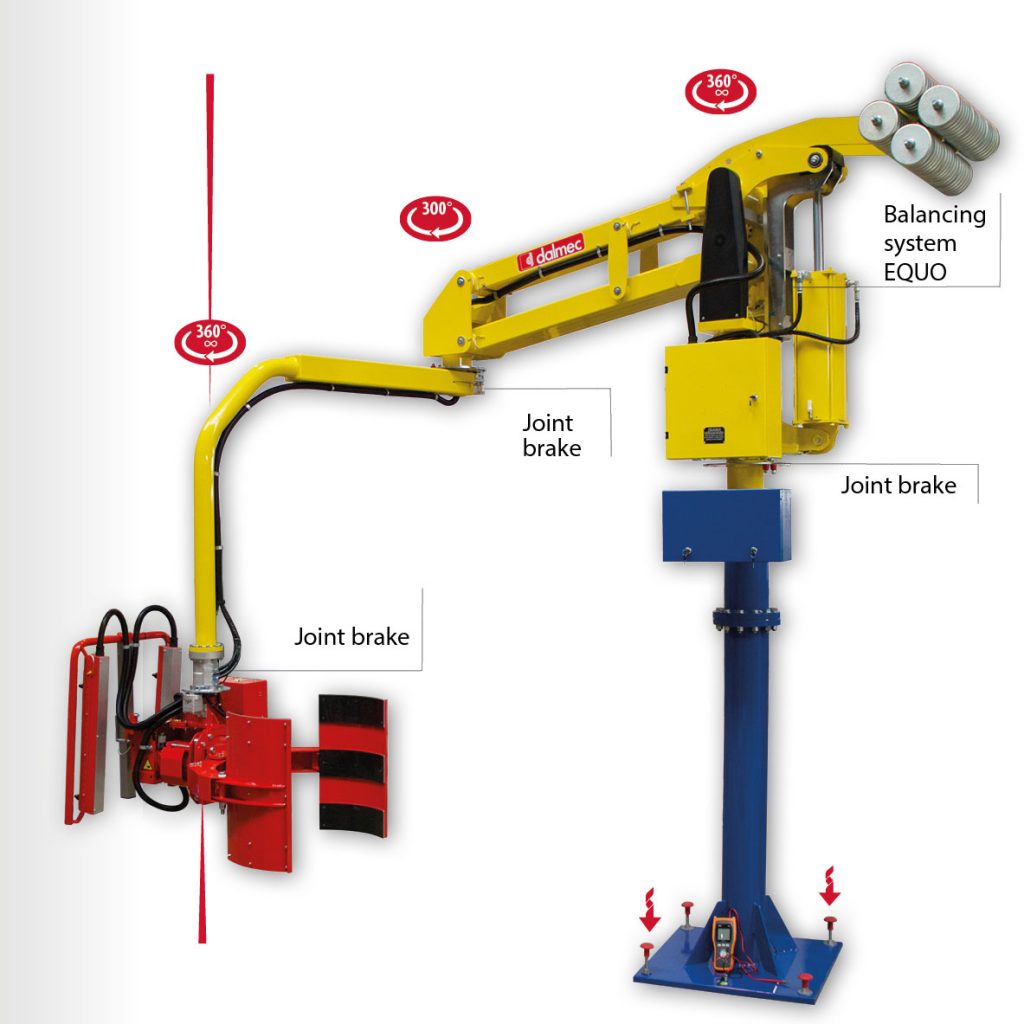
Manipulators with Rigid Arms
Rigid arm manipulators are designed for stable, controlled handling where precise positioning matters. They are ideal for heavier or off-centre loads and applications requiring rotation, tilting, and exact placement.
Manipulators with Cable
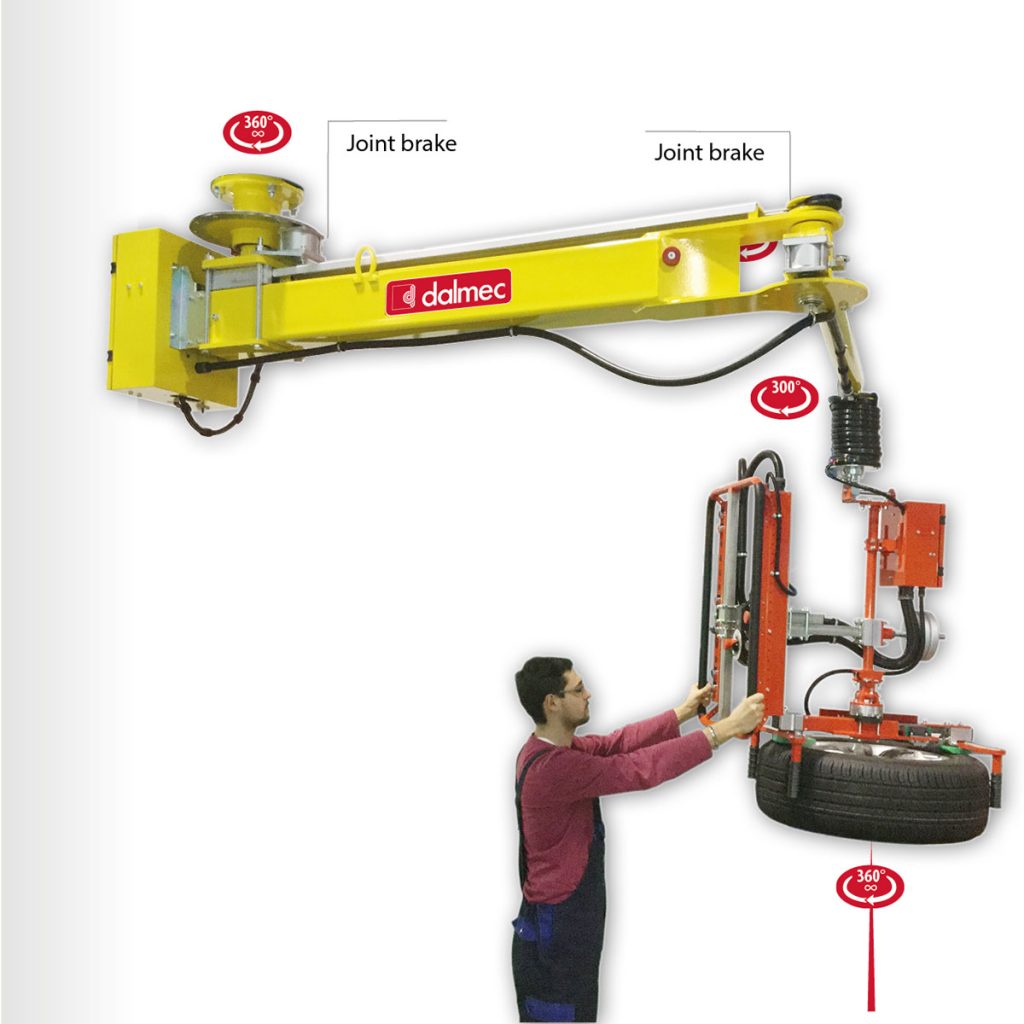
Industrial Manipulator or Cable Balancer?
Choosing the right system starts with understanding your task. Both product families are purely pneumatic and custom-engineered, but they are designed for different types of handling.
Industrial Manipulator
Choose this when your task requires more than vertical lift.
A rigid-arm manipulator is the right choice when your load needs to be tilted, rotated, or precisely positioned during the handling cycle. Loads that are heavy, off-centre, or irregular in shape, tasks that require multi-axis movement, and applications where placement accuracy matters are all suited to the manipulator range. Industrial manipulators handle loads from 6kg to 1,500kg and are mounted to a fixed column, overhead rail, or floor structure depending on your layout.
Cable Balancer
Choose this when your task is primarily repetitive vertical lift.
A cable balancer is suited to lighter or more balanced loads that follow a simple up-and-down handling path. When the task is high-frequency vertical transfer and the load does not require tilting, rotating, or complex positioning, a balancer delivers efficient, low-fatigue handling at a lower capital cost than a full rigid-arm manipulator. When the task is straightforward vertical transfer and the load is consistent in shape and weight, a cable balancer is the right tool for the job.
Not sure which is right for your task? Tell us the load, the motion, and how many times per shift. We will tell you exactly which system fits.
See full comparison →
Identify your highest-risk manual handling task.
Download the free Workflow Strain Index.
Prefer a direct conversation? DM Luke on LinkedIn →
Discover our MANIPULATORS
- 11 Models designed to satisfy all handling requirements in every industrial sector.
- DALMEC Industrial Manipulators allow the ergonomic, safe and effective handling of any product.
- We are able to lift every kind of product weighing from 6 up to 1500 kg using compressed-air only.

Manual handling of loads
Legislative decree No. 81 dated 09/04/2008.
- NIOSH method for the Lifting Index in the Manual material handling
- Snook and Ciriello method for the activities such as pushing, pulling and transport loads on floor surfaces.
These rules are applied to the activities involving the manual handling of loads with risks to the operators of injuries to the back.
The workplace must be fitted with proper means to reduce the risks deriving from the manual handling of loads.
When it is not possible to avoid the manual handling of the loads (lifting, pushing, drawing, transport), the employer must provide the worker with suitable means to reduce the risks deriving from these operations.
Limit values for the lifting of loads:
- Kg 25 Adult males
- Kg 20 Adult females
- Kg 20 Teenage males
- Kg 15 Teenage females
There are coefficients of reduction of the limit values, which consider:
- Height of the hands from the ground at the beginning of lifting
- Vertical distance of the load from the beginning to the end of the lifting cycle
- Distance between the load and the body during lifting
- Rotation of the bust for angular displacement of the load
- Possibility of taking the load.
The installation of mechanical arms also for weights lower than 30 kg, enables the operator to:
- Work quicker
- Notably reduce physical fatigue
- Eliminate the risk for the back
- Non-skilled personnel to carry out manual handling
- Reduce the risk of injuries.
Benefits of using Dalmec manipulators
- Enhance Productivity and Cost Efficiency
Transform a task that previously required two or three individuals into a one-person operation.
Achieve a more sustainable workload for operators.
- Elevate Safety, Job Satisfaction, and Morale
Minimise work-related fatigue and stress.
Simplify or promote job rotation, encouraging a safer and more satisfying work environment.
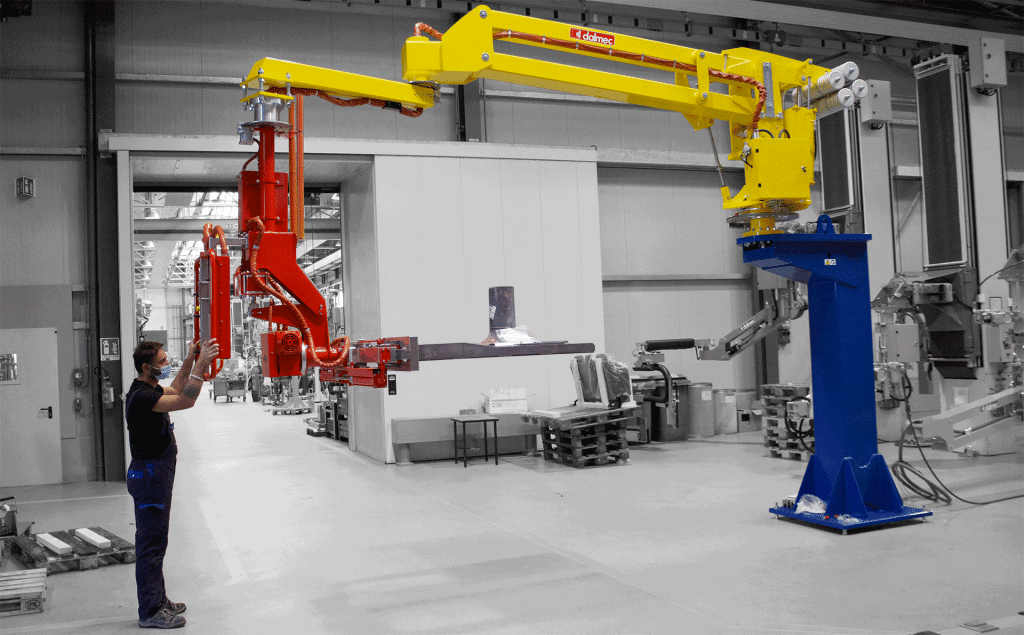
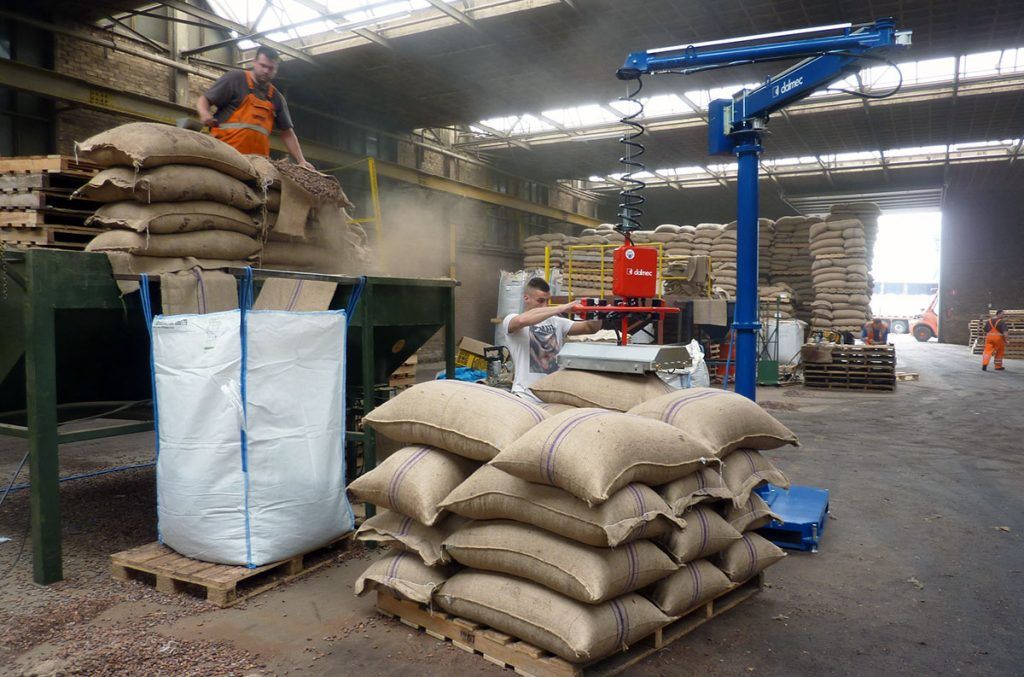
Precision, safety and efficiency – delivered.
Two critical components of successful manufacturing are precise and safe movement.
Dalmec’s manipulators and material handling devices meet strict safety standards and are built with the protection of the user in mind, ensuring high-quality, long-lasting machines that are customized to meet customers’ unique needs.
“We are committed to sustainability – for every Dalmec machine sale, we plant a tree.”
FAQ
How does a pneumatic industrial manipulator work?
Every Dalmec manipulator runs on compressed air only. The system continuously adjusts air pressure to counterbalance the exact weight of the load, keeping it suspended at whatever height the operator sets it. At that point the operator is no longer carrying anything. They are guiding. The
physical demand of lifting is removed from the task entirely, which means consistent performance across a full shift with no fatigue accumulation. Because there are no electrical motors or control electronics in the arm itself, Dalmec manipulators perform reliably in demanding conditions including wash-down areas, paint booths, dusty fabrication environments, and ATEX-rated hazardous zones where electrical components create risk.
What are the main benefits of using an industrial manipulator?
The primary benefit is a significant reduction in workplace injury risk. By removing the physical demand of manual handling, Dalmec manipulators help prevent Musculoskeletal Disorders (MSDs) and Repetitive Strain Injuries (RSI), the leading categories of serious workers’ compensation claims in Australian workplaces. Beyond safety, they improve operational efficiency by allowing a single operator to handle loads that would otherwise require two people or a slower crane or hoist system. Consistent output, reduced fatigue, and improved operator retention are the downstream operational gains.
Can industrial manipulators be customised for specific tasks?
Yes. Unlike standard lifting equipment, the most effective industrial manipulators are bespoke. At Dalmec, we engineer custom gripping tools (end-effectors) tailored to the specific geometry of the product, whether it is a vehicle component, a roll of material, a heavy carton, or a chemical drum. This ensures the load is held securely and can be manoeuvred into the exact orientation required for the next stage of production or handling.
Do Dalmec manipulators comply with Australian workplace safety regulations?
Yes. All Dalmec installations in Australia are designed to meet and exceed applicable workplace safety requirements. Our systems are engineered as engineering controls, the highest level of control in the hierarchy of controls under the Work Health and Safety Act 2011 and the Model WHS Regulations (hazardous manual tasks). Each installation is documented to support a PCBU’s duty to eliminate or minimise manual handling risk so far as is reasonably practicable. Dalmec systems carry EC/CE certification to European Machinery Directive standards, and VLM holds Australian compliance certification for local installations.
Does Dalmec have nationwide installation and service support in Australia?
Yes. VLM, the exclusive Australian and New Zealand distributor for Dalmec, has installed over 650 Dalmec manipulators in workplaces across every state and territory. Our experienced team coordinates site assessment, custom engineering, installation, commissioning, and after-sales service nationally. Whether your facility is in Perth, Sydney, Melbourne, Brisbane, Adelaide, or regional Australia, we provide local support backed by Dalmec’s global engineering network.
How does a custom material handling solution improve overall productivity?
By replacing manual lifting with a Dalmec engineered manipulator or balancer, businesses reduce operator fatigue, prevent injuries, and maintain consistent production speeds across a full shift. Unlike a human operator whose output degrades with fatigue, a Dalmec system delivers the same handling performance at the start of the shift as the end. These improvements lead directly to higher throughput, fewer delays, reduced rework from handling errors, and measurable cost savings over the system’s 20+ year service life.