

Safe lifting training does not stop injuries. It just means the paperwork is in order when one happens.
That line usually gets a reaction when I say it on a warehouse floor. But it reflects the reality most WHS managers and operations leaders already understand.
Your team lifted that carton 400 times today. Tomorrow they will do it again. At what point does that stop being a lifting task and start being an injury waiting to happen?
What I Saw on the Floor
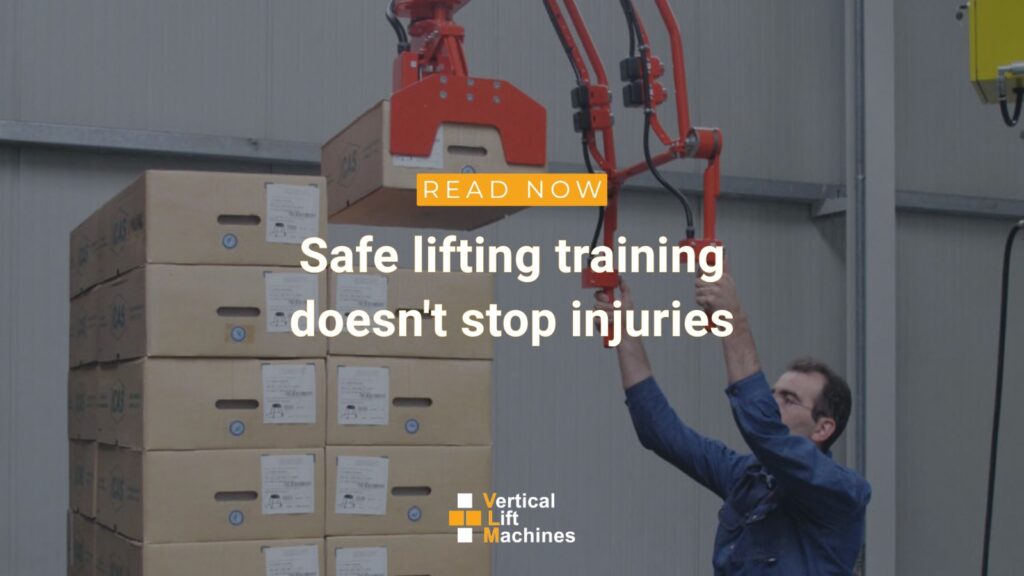
Last week I was in a warehouse watching a team move cartons from inbound pallets onto a packing line. Nothing unusual. The cartons were well within the stated manual handling weight limit. Everyone had completed safe lifting training. The process technically ticked every administrative box.
But what I saw was a worker repeating the same reach, lift, rotate, and place motion hundreds of times across a shift. The lift was 12kg. The problem was it happened 350 times a shift.
The carton itself was not the risk. The motion was. And that distinction is where most workplaces still get caught out.
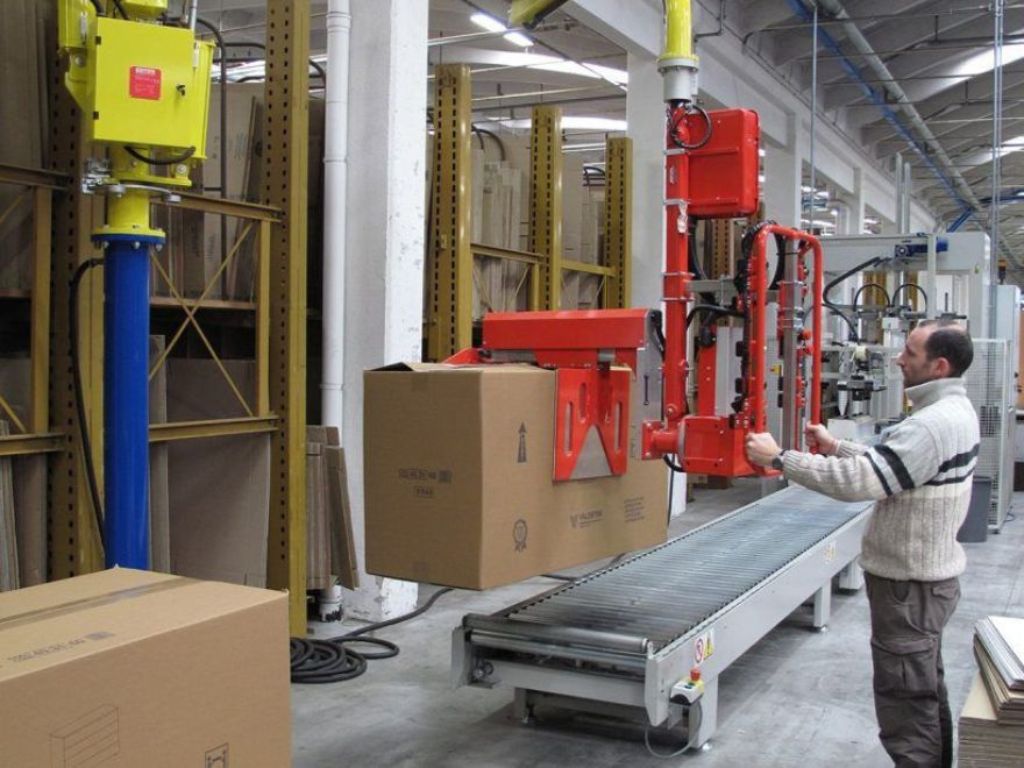
A repetitive handling task like this is exactly where a Dalmec industrial manipulator becomes the right engineering answer.
Why Lifting Limits Are the Wrong Measure
Most manual handling policies still revolve around weight limits. If the carton is under a certain number of kilograms, the task is considered safe enough, provided workers have been trained in correct lifting technique. That logic is deeply embedded in most workplaces.
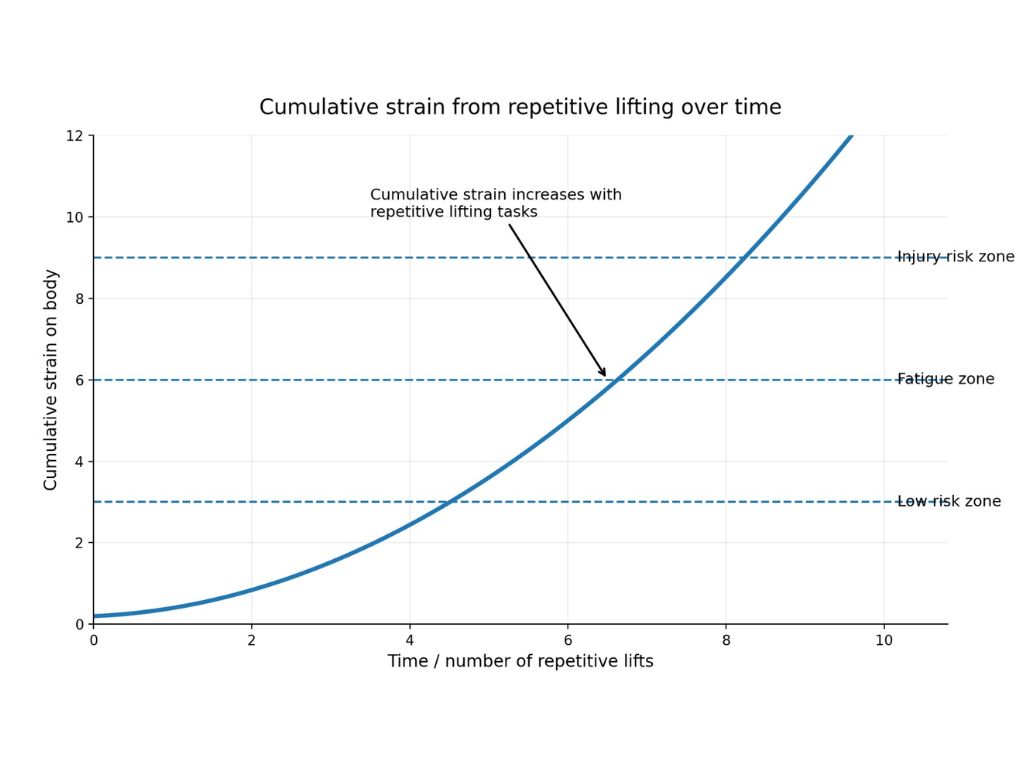
The problem is that injuries rarely come from a single heavy lift. They come from cumulative motion exposure.
Manual handling risk is not weight. It is weight multiplied by frequency multiplied by motion complexity.
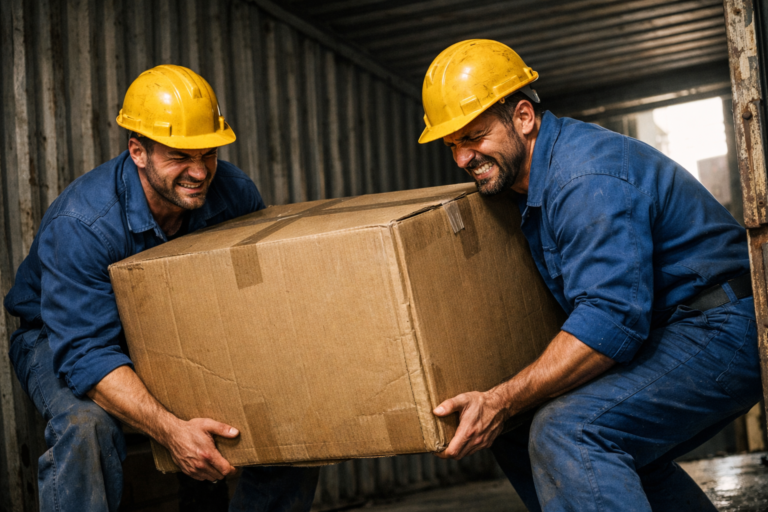
A 10kg carton lifted once is a trivial task. A 10kg carton lifted 400 times in a shift is 400 repetitions of spinal loading, shoulder rotation, and grip force. Even if every lift is technically within limits, the cumulative exposure becomes significant over time.
That is why warehouses with relatively light cartons still report high rates of musculoskeletal injuries. The risk sits in the frequency, reach distance, and awkward positioning. When I walk a warehouse floor, the first thing I watch is not the load but the motion pattern. How far is the worker reaching? How often is the lift repeated? Is the load rotated mid-air? Those are the variables that determine whether a task becomes an injury risk.
What Motion Exposure Actually Costs
By the time an injury claim appears, the real cost has already been accumulating for months.
Injury Exposure
Repetitive manual handling is the leading cause of serious workers compensation claims in Australia. Body stressing accounts for 34.5 percent of all serious claims. The average direct cost per claim is $16,300. When backfill, overtime, rehabilitation, and insurance premium increases are counted, the all-in cost typically sits between $50,000 and $100,000.
As Safe Work Australia makes clear, employers are expected to manage handling risks, not just document them.
Labour Retention
Physically demanding roles drive turnover. People leave these roles and they rarely say why. They quietly stop putting their hand up for that shift, then stop showing up altogether. For a warehouse or production floor, losing a trained operator costs more than replacing them. The knowledge that walks out the door is harder to quantify than the recruitment fee.
Productivity Loss
Fatigue degrades performance as the shift progresses. Throughput drops, placement accuracy falls, and errors increase. Fatigue is not a personnel problem. It is a workflow design failure.
What the WHS Act Actually Requires
Under the Work Health and Safety Act 2011, employers have a duty to eliminate risks to health and safety so far as reasonably practicable. Where elimination is not possible, they must minimise the risk using the most effective controls available.
Training is an administrative control. It sits near the bottom of the Hierarchy of Controls. Administrative controls rely on human behaviour. They assume workers will consistently apply the correct technique across hundreds of repetitions, often while fatigued, often under time pressure.
Engineering controls sit much higher in the hierarchy because they remove the physical exposure at the source. They change the task itself rather than asking the worker to manage the risk within it.
A documented engineering control is what a WHS manager needs when a regulator or insurer asks what the business did about a known manual handling risk. A training register does not close that gap.
The Real Shift in Thinking
For most operations, the question has always been: is the load within the lifting limit?
The right question is: is this motion sustainable across an entire shift?
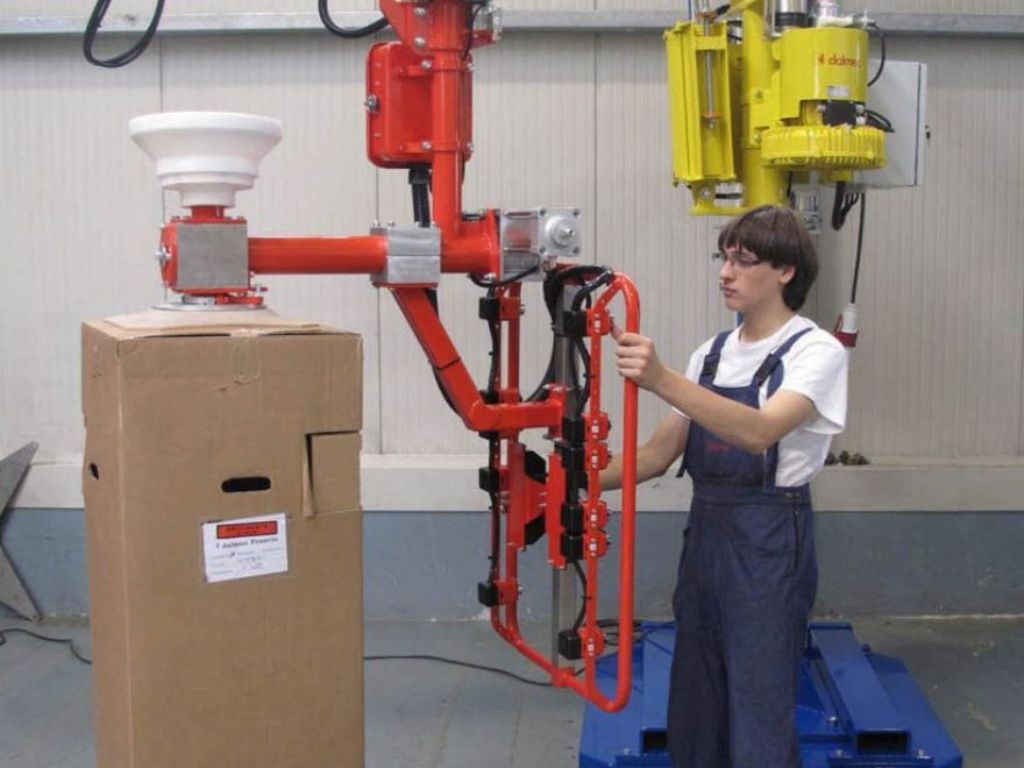
When that question becomes the frame, the solution moves away from training and toward engineering design. Instead of asking how to train workers to lift safely, the question becomes how to redesign the motion so workers do not carry the load at all. That is the principle behind engineered motion control, and it is the difference between an administrative fix and a genuine engineering control.
Why Cranes and Vacuum Lifters Are Not the Same Solution
If a jib crane or overhead crane is the current solution for repetitive carton movements, it is likely managing vertical load only. Rotation, reach, and repeated fine placement require a different class of engineering control.
Cranes lift. They do not provide controlled positioning through the full motion path. Other common substitutes, including vacuum lifters, balancers, and smart hoists, can assist with the load in simple applications. But they typically lack the controlled multi-axis positioning that a repetitive handling task requires.
Industrial manipulators provide what those alternatives do not:
- Tilt and rotation under load
- Controlled handling of offset or awkward loads
- Precision placement at the end of the motion path
- Stability and repeatability across hundreds of cycles per shift
The risk in a repetitive carton handling task is not just the weight. It is the motion. A tool that only addresses the weight leaves the motion problem unsolved.
Where This Problem Appears Across Industry
The carton handling challenge is one of the most common, but the same underlying motion design problem appears in different forms across most industrial environments.
Warehousing and Logistics
High-volume carton palletising, bag handling, and repetitive pick-and-place tasks in distribution centres and 3PL facilities. High shift frequency and labour turnover make this the most common application.
Food Manufacturing
Repetitive bag, container, and ingredient handling in production lines. Hygiene requirements and wet or slippery surfaces make controlled handling especially important.
Chemical Industry
Drum and pail handling where load weight and hazardous contents create both physical and safety risks. Precision placement at filling or dispensing stations is a common application.
Steel Fabrication
Plate, component, and part positioning where weight, awkward geometry, and precision placement requirements combine. Engineering control over the full motion path is critical to safe handling and part quality.
Because every workflow is different, Dalmec customises every industrial manipulator around the specific task, load, and layout before any system is installed.
The Commercial Case Over the Life of the System
The upfront investment is usually the first objection. It rarely holds up under scrutiny.
A $60,000 system over a 20-year service life costs $3,000 per year. A single manual handling claim averages $16,300 in direct costs, and $50,000 to $100,000 when indirect costs are included.
Compare the cost of a Dalmec installation against:
- Ongoing recruitment and retraining costs for physically demanding roles with high turnover
- Lost productivity as throughput drops late in the shift due to fatigue
- Insurance premium increases following claims history
- Regulator scrutiny following a known and unaddressed risk
Dalmec is not cheap equipment. It is a long-life engineered system. The commercial comparison is not against other lifting products. It is against the ongoing cost of doing nothing.
When Businesses Usually Act
Most operations know which task is the problem long before they do anything about it. Action usually follows a specific trigger:
- A workplace injury or near-miss on a specific task
- A WHS improvement notice or regulator visit
- An insurance premium increase tied to a claims history
- A production bottleneck caused by fatigue-driven inconsistency
- A new facility design or line upgrade that creates the opportunity to do it properly
The Risk Most Safety Frameworks Still Underestimate
Manual handling injuries rarely come from a single heavy lift. They come from hundreds of perfectly normal lifts, repeated every day. That is the exposure most administrative frameworks are not designed to address.
Removing manual strain protects workers, stabilises productivity, and helps retain experienced operators. When the question shifts from weight compliance to motion design, the solution changes. Training records do not close the gap. An engineering control does.
When the motion is redesigned, the injury exposure drops. And when the injury exposure drops, retention, compliance, and throughput tend to follow.
Send the task details. Load weight, lifts per shift, and motion type. We will tell you whether an engineered solution makes sense.
Reach out on LinkedIn, or submit your details via vertistore.com.au. If you want to run your task through the Warehouse Workflow Strain Index first, message us directly. It is free and takes less than a day.
Readers ready to explore the broader range can review Dalmec lifting and handling solutions before getting in touch.
Frequently Asked Questions
Can a Dalmec manipulator replace a two-person lift?
Yes, and in most cases that is exactly the point. A two-person lift doubles the number of workers exposed to the same repetitive handling risk. It does not halve the risk per person across a full shift. When a task regularly requires two people, the workflow is already signalling that it exceeds what one person should be absorbing. A Dalmec manipulator is engineered to allow a single operator to perform the same task with controlled, precise handling and near-zero physical strain. One person. The same output. A documented engineering control on record.
Are industrial manipulators safer than cranes for repetitive tasks?
For repetitive handling tasks that require controlled positioning, rotation, or fine placement, yes. Cranes manage vertical load but do not provide the controlled multi-axis positioning that reduces cumulative strain exposure. A manipulator changes the task itself rather than assisting the worker within an unchanged task. Under the Hierarchy of Controls, a properly installed manipulator is a documented engineering control, which ranks above training and procedural approaches.