
Near Misses in Chemical and Drum Handling: The Injury Data You Are Not Collecting
Published by Vertical Lift Machines | August 2026 | Category: WHS / Manual Handling
Nobody writes up the drum that nearly went over.
The grip that gave for half a second on a wet chime. The drum steadied against a thigh halfway through a tip. The second operator who stepped in because the angle looked wrong from across the bay. The IBC that swung wider than anyone expected coming off the forks. On a chemical or drum-handling floor these happen every week, and almost none of them make it into a report, because the form is for injuries and nobody was injured.
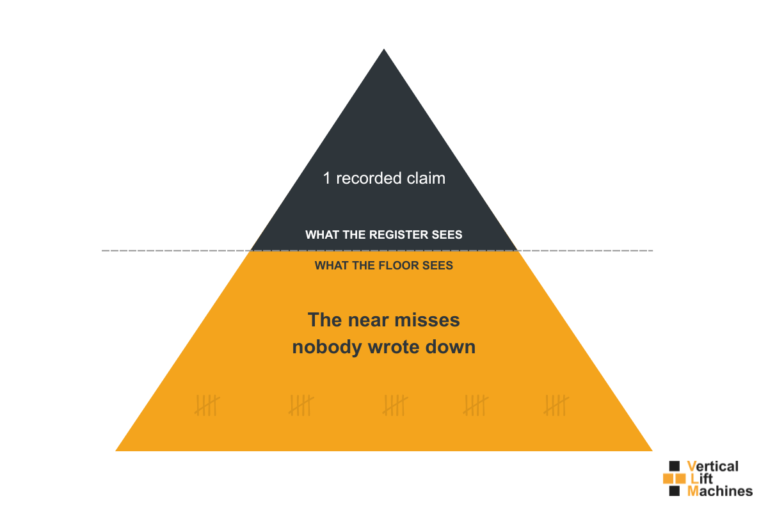
So the incident register stays clean while the same task keeps producing the same moments, shift after shift. The paperwork says the floor is safe. The floor is saying something else.
This is not a reporting-culture lecture. It is a measurement problem, and it has a practical fix: treat near misses as data, collect them for one month on one task, and let the count make the case the injury statistics cannot make until it is too late.
What a Near Miss Looks Like in Drum Handling
The textbook near miss is a dropped load that lands next to a boot. Real ones are quieter. On chemical and drum-handling tasks they look like this:
- A grip that slips and is caught – the drum is wet from washdown, oily from the line, or heavier than the label says because the product has settled.
- A drum steadied against the body – controlled with a hip or thigh halfway through a tip because two hands are not enough to hold the angle.
- An unplanned second person – someone jumps in mid-lift because one operator clearly cannot land it. Not a rostered team lift; a rescue.
- A rushed placement – the drum lands on the pallet or in the bund harder than intended because holding it any longer was not an option.
- A changed technique late in the shift – the lift that was done properly at 7am is done differently at 2pm, to spare a wrist or a back that is already feeling it.
None of these produce an incident report. All of them are the same event as an injury claim, minus the timing. The force, the posture and the fatigue were all present. The only thing missing was the half-second where it goes wrong.
Lagging Indicators Count Your Injuries. Leading Indicators Predict Them
Most WHS reporting on chemical and drum-handling floors runs on lagging indicators: lost-time injuries, claims, days off work. They are accurate, auditable, and useless for prevention, because by the time a lagging indicator moves, the injury has already happened.
Near misses are the leading indicator for manual handling, and regulators treat hazardous manual tasks as a risk to be managed before harm occurs, not after – the Safe Work Australia guidance on hazardous manual tasks] is built around identifying force, posture, repetition and duration in the task, not around waiting for a claim.
A near miss on a drum lift is those risk factors photographing themselves a moment before the injury. Enough of them, on the same task, is not a run of luck. It is a schedule.
One Task, One Month: How to Collect the Data
You do not need a new reporting system, a software platform or a culture program to start. You need a clipboard, one task and one month.
Pick the handling task your own people already talk about – the drum off the pallet and into the bund, the pour into the mixing vessel, the pails up to the mezzanine, the bags of powder into the hopper. Then count, for one month, four things: near-drops, loads steadied against the body, unplanned second-person assists, and visible changes of technique late in the shift. Tell the crew what you are counting and why. They will tell you things the count misses.
At the end of the month you have something the incident register cannot give you: a number that describes the task, not the casualty. That number belongs in the risk register against the task, and it converts directly into the language your WHS obligations are written in – evidence that the hazard is known.
What the Count Justifies: An Engineering Control
Once the near-miss count says the task is a matter of time, the hierarchy of control says what to do about it. Admin controls – procedures, toolbox talks, rotation – change the paperwork around the lift. PPE changes what the operator wears during it. Neither changes the lift. An engineering control does.
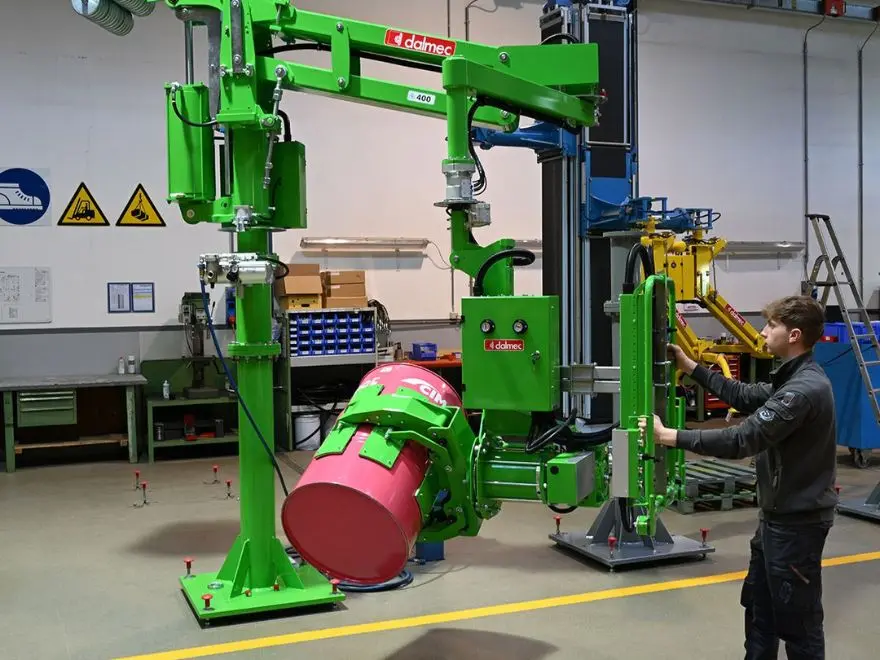
A pneumatic industrial manipulator is an engineering control for exactly this class of task: the machine carries the full weight of the drum, and the operator guides it with one hand. A tired grip cannot drop a load it is not holding. That is what our Dalmec industrial manipulators do on chemical and drum-handling floors: drums off pallets and into bunds, controlled tipping into mixing vessels, pails and kegs between stations, and containers on and off the line.
The tooling is engineered to the part – chime grippers and parallel jaws for drums, controlled-tipping tooling for pours, clamp tooling for pails and kegs – and the balancing is tuned so the load floats and the operator only steers. The near-miss mechanisms disappear because the operator’s strength, grip and fatigue are no longer what holds the drum in the air. Where the movement is the hazard – rotation, tilting, precise placement – the engineering approach to the whole handling task covers that too: the rotation is pneumatic, the tilt is controlled, the placement is guided.
Solved Before, at Scale
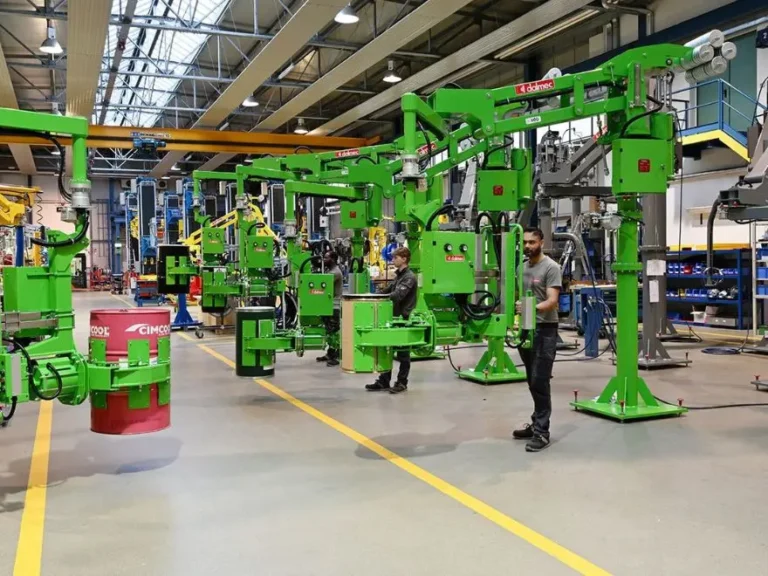
Drum handling is not a new problem for this equipment. Dalmec has been building industrial manipulators since 1963, and drums, pails and containers are among the founding application families. There are over 70,000 Dalmec manipulators installed worldwide, and more than 650 across Australia and New Zealand – many of them doing precisely the lifts described in this article, every shift, for decades of service life.
When we assess a drum-handling task we are pattern-matching against installations that already run. The applications across the chemical and drums sectors cover the receiving, blending, filling and despatch ends of the same floor.
If the Count Comes Back High
Not every task justifies a manipulator, and we will tell you when yours does not – a lift that happens twice a week is a different conversation from one that happens two hundred times a shift. But if one month of counting puts a number on a task your own crew already avoids, the next step costs you three details, not a capital commitment.
Load weight, as the part is actually handled. The movement required, described as verbs and angles. Lifts per shift. With those three we will tell you whether an engineering control is available for the task, what it looks like, and an indicative cost – the same three-detail assessment that turns a near-miss count into a business case your finance meeting can approve.
Start With Three Details
Load weight. Movement required. Lifts or placements per shift.
That is all we need to tell you whether an engineering solution makes sense for your floor.
dalmec.au | 1300 886 277
Vertical Lift Machines Pty Ltd is the authorised Dalmec distributor for Australia and New Zealand. Dalmec pneumatic manipulators are installed across 650+ sites in Australia and New Zealand, including chemical manufacturers, blenders and drum-handling operations across the sector.
Frequently Asked Questions
What counts as a manual handling near miss?
Any moment where the lift nearly went wrong without an injury: a slipped or caught grip, a load steadied against the body, an unplanned second person stepping in, a rushed or dropped placement, or a visible change of technique to protect a tired back or wrist. If it would have been an incident report with worse timing, it is a near miss.
Do near misses have to be reported under WHS law?
Most manual handling near misses are not notifiable to the regulator. But a PCBU must manage the risk of hazardous manual tasks, and near misses are direct evidence that a task carries that risk. Counting them internally is how you demonstrate the hazard is identified and acted on, rather than discovered by the first claim.
How many near misses should trigger action?
There is no magic threshold. A repeating pattern on the same task is the signal – the count is telling you the risk factors are present every shift. One month of honest counting on one task is usually enough to decide whether the task needs an engineering control assessed.
Does a manipulator eliminate the near-miss risk entirely?
It removes the mechanisms behind the common ones: the machine carries the full weight, so grip strength, fatigue and posture no longer decide whether the load stays in the air. It is an engineering control, level three of the hierarchy, and it can be documented as such in your WHS records for the specific task. Residual risks are addressed in the machine design – anti-drop devices are standard practice on lifting tooling.
Which chemical and drum-handling tasks suit a manipulator?
Drums off pallets and into bunds, controlled tipping and pouring into vessels, pail and keg handling, and container transfer on and off the line are all proven applications – drum handling is one of Dalmec’s founding tooling families. If the lift is heavy, wet, awkward or repeated, it is worth assessing. Start with load weight, movement and lifts per shift.