Manual Handling on Vehicle Assembly Lines: Why a Signed SWMS Is Not a Control
Published by Vertical Lift Machines | July 2026 | Category: WHS / Manual Handling
A signed SWMS is not a controlled risk. It is a documented one. Under the WHS Act, those are not the same thing.
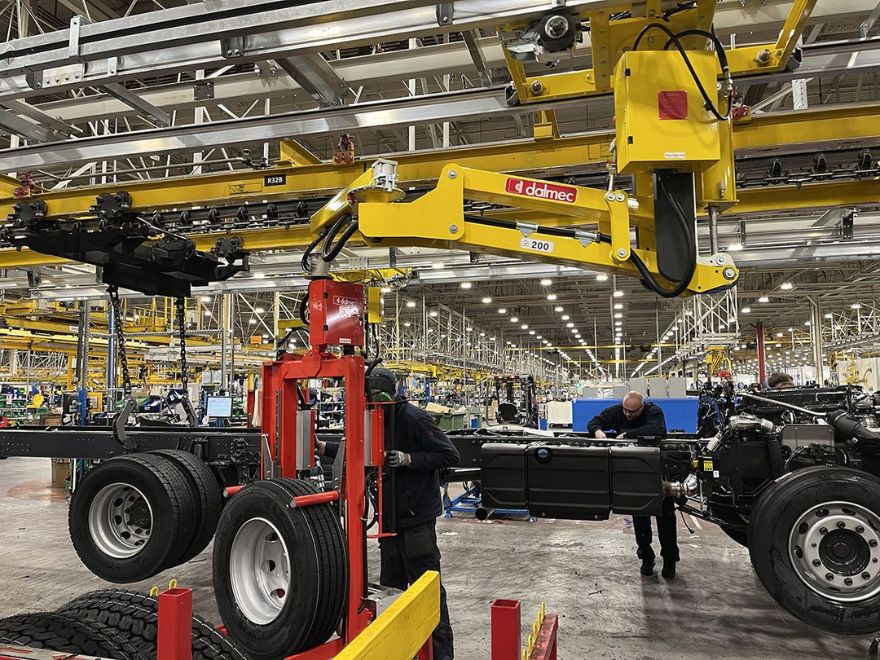
Building a truck, a bus or a trailer is heavy work by design. Seats go in flat and come out vertical. Wheel-and-tyre assemblies run 60 to 80 kilograms and get lifted to the hub dozens of times a shift. Axles are rotated and placed by hand. Leaf springs are tilted into suspensions. EV battery packs are among the heaviest single parts on the vehicle. On most lines the paperwork around that work is clean: the risk assessment is current, the SWMS is signed, the rotation roster is on the wall.
None of that is what a WorkSafe inspector assesses after a manual handling injury. They assess whether the hazard was controlled. On a vehicle line, the gap between a documented hazard and a controlled one is usually where the claim came from.
This is not a documentation problem. It is a control problem. And the WHS Act is unambiguous about which one it requires.
What the WHS Act Requires for Manual Handling on a Vehicle Line
The WHS Act does not ask whether each lift was within a recommended weight limit, or whether your operators were trained, inducted and rostered through a rotation schedule. It asks whether you took all reasonably practicable steps to eliminate or minimise the risk.
“Reasonably practicable” is a practical test, not an aspirational one. It weighs the benefit of a control against the cost of implementing it. For a repetitive heavy lift performed across a full shift on a vehicle line, an engineered handling solution spread across its service life is rarely disproportionate to the injury risk, the WorkCover exposure and the throughput inconsistency the manual task keeps generating.
What a WorkSafe inspector assesses after a musculoskeletal injury claim is not whether the paperwork was in order. It is whether the employer knew the task created a risk, and whether they implemented the most effective control that was reasonably practicable. A rotation schedule and a signed SWMS do not settle that question in the employer’s favour when a mechanical solution was available. In practice, the first documents an inspector asks for are the risk assessment that identified the task and the record of what was done about it. A gap between the two is the finding.
Why a SWMS and a Rotation Roster Are Not Controls
A risk assessment identifies a hazard. A SWMS describes how to perform it. A rotation roster shares it around. None of the three reduces the hazard in the task itself.
This matters on a vehicle line because the tasks are so repeatable. The lifts that show up on nearly every line:
- Seats – arrive flat, go in vertical through a narrow door, without scuffing trim. Light to lift, hard to place cleanly by hand, shift after shift.
- Wheels and tyres – 60 to 80 kg assembled, lifted, rolled and aligned to the hub, often two people, dozens of times a shift.
- Axles – heavy, and they have to be rotated and placed precisely onto a bench or into the vehicle.
- Leaf springs – long, heavy and awkward, needing a tilt to fit a heavy-vehicle suspension.
- EV battery packs – among the heaviest single parts on the vehicle, placed into the chassis to the millimetre.
Rotate more operators through any of those and you have not reduced the risk. You have exposed more people to it. That is a scheduling decision, not an engineering control, and an inspector reads it that way.
Where a Manipulator Sits in the Hierarchy of Control
The hierarchy of control ranks risk management from most to least effective:
- Elimination
- Substitution
- Engineering controls
- Administrative controls – rotation schedules, training, SWMS, induction
- Personal protective equipment
A risk assessment does not appear on that list. It precedes it – it identifies the hazard the hierarchy then has to address. When the assessment confirms a repetitive vehicle-line lift creates musculoskeletal disorder (MSD) risk, the Act requires you to implement the most effective control that is reasonably practicable. Engineering controls sit at level three. Administrative controls sit at level four. If a mechanical solution is available and affordable, documenting a rotation schedule does not substitute for it.
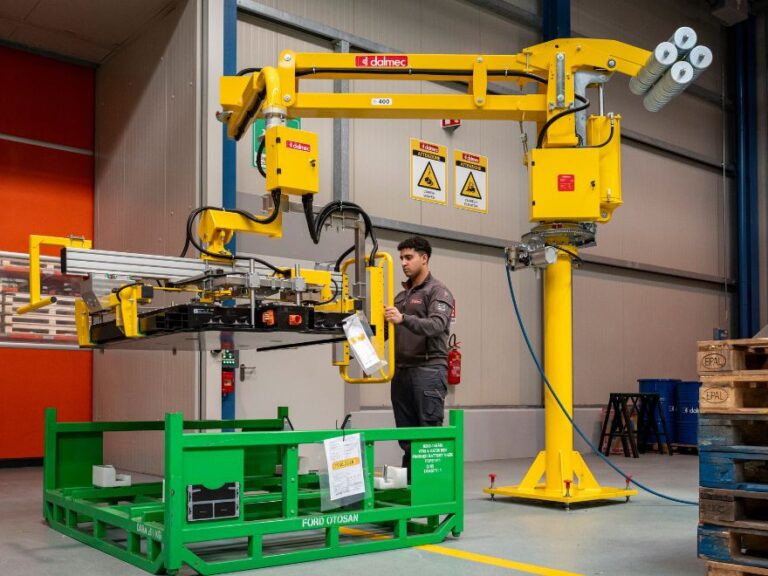
A Dalmec pneumatic manipulator is an engineering control. It physically changes the task: the machine carries the weight, the operator guides the load. That is the difference between managing a hazard on paper and removing it from the task.
What a Vehicle Assembly Line Demands From an Operator
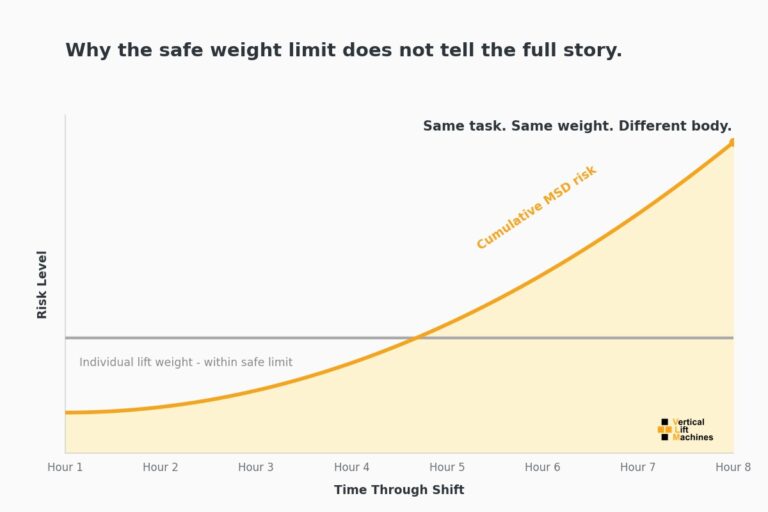
A vehicle assembly line is engineered for consistent throughput. It runs at the same pace in hour eight as in hour one. The battery pack does not get lighter as the shift goes on. The placement tolerance on a seat or an axle does not widen because the operator is tired. But the operator changes.
Take a wheel-and-tyre station. A 70 kilogram assembly, lifted from a stillage, rolled to the hub, held level and aligned to the studs. At 7am it is a two-person job done cleanly. By the fortieth wheel the grip is tireder, the back rounds a little earlier, and the alignment gets rushed because the line does not slow down. Multiply one station by a shift, and a shift by a year, and the cumulative load on that team is enormous, none of it visible in the paperwork.
Fatigue on a repetitive lift does not present as obvious exhaustion. It presents as small, invisible adjustments: a grip that shifts to spare a sore wrist, a lift that shortcuts a rotation to save the back, a pace that slips because holding the designed cycle time across eight hours is no longer physically possible.
These adjustments are not a discipline issue. They are the MSD claim in progress – invisible until they result in a recorded injury, by which time the exposure has been building across dozens of shifts.
The risk assessment did not model this. The rotation roster does not resolve it. Moving the affected operator to a different task reduces that individual’s exposure, but the task continues, and the next operator begins absorbing the same load.
A Dalmec manipulator removes the variable. On that same wheel station, the manipulator takes the full weight of the assembly and the operator guides it to the hub with one hand, level and aligned, without a second person and without a hard lift. Cycle time stays consistent from the first component of the shift to the last. Grip strength, posture and cumulative fatigue are no longer factors in whether the task is completed within tolerance and without injury.
Three Details That Determine Whether a Solution Is Viable
Most operations assume an engineered handling solution means significant cost, complex installation, or disruption to the line. In our experience none of those are reliable starting points. A Dalmec install is designed around the specific task, not retrofitted from a catalogue. The three data points that determine viability are:
Load weight – the real mass of the component as it is handled, not the catalogue figure.
Movement required – lift only; lift and rotate; tilt; transfer along the line; place into a fixture; orientate for assembly.
Lifts per shift – how many times the task runs across a standard shift.
Those three details let us specify a machine configuration, confirm it fits the application and workspace, and provide an indicative cost. A site visit follows if the application is viable. A pneumatic manipulator is a long-life asset – typically 15 to 20 years of service – so when the cost is spread across the life of the machine and set against a task performed hundreds of times a shift, the “reasonably practicable” test is rarely close. There is no obligation beyond that assessment, but it gives you the documented information to make a defensible decision about whether the control is reasonably practicable, which is exactly what the WHS Act requires of you.
If Your Risk Assessment Has Already Flagged the Task
If your current risk assessment identifies a repetitive vehicle-line lift as a known hazard, and the documented control is rotation or training, the next step is straightforward. Collect the three details above. Send them to us. We will tell you whether a Dalmec solution is available and what it costs indicatively.
If that cost is not grossly disproportionate to the benefit – and the benefit includes documented injury prevention, consistent throughput across the full shift, and reduced WorkCover exposure – then implementing the control is almost certainly required under the WHS Act.
The risk assessment did its job. It identified the hazard. The obligation is the next step: the control.
Start With Three Details
Load weight. Movement required. Lifts or placements per shift.
That is all we need to tell you whether an engineering solution makes sense for your line.
dalmec.au | 1300 886 277
Vertical Lift Machines Pty Ltd is the authorised Dalmec distributor for Australia and New Zealand. Dalmec pneumatic manipulators are installed across 650+ sites in Australia and New Zealand, including the automotive and commercial-vehicle sector where Dalmec has supplied Australia’s major vehicle makers.
Frequently Asked Questions
Is a signed SWMS enough to meet the WHS Act for manual handling on a vehicle line?
No. A SWMS describes how a task is performed. It is an administrative control, level four of the hierarchy. If a repetitive vehicle-line lift creates MSD risk and an engineering control is reasonably practicable, the Act requires you to implement the engineering control. A SWMS does not substitute for it.
Is job rotation an engineering control?
No. Rotation is an administrative control. It reduces how long any one operator is exposed to a hazardous lift, but it does not reduce the hazard in the task. Rotating more people through the task spreads the exposure rather than removing it.
Does a Dalmec manipulator count as an engineering control?
Yes. A pneumatic manipulator physically changes the task: the machine carries the load and the operator guides it. That satisfies the hierarchy of control at level three and can be documented in your WHS records as an engineering control for the specific task.
Which vehicle-line tasks are suitable for a manipulator?
Seats, wheels and tyres, axles and driveline parts, leaf springs and suspension components, fuel tanks, panels and EV battery packs are all common applications. If a lift is heavy, awkward, repeated, or needs two people, it is worth assessing. Start with load weight, movement and lifts per shift.
What does “reasonably practicable” mean in cost terms?
It weighs the cost of a control against its benefit and asks whether the cost is grossly disproportionate. For a high-frequency vehicle-line lift, a manipulator spread across its 15 to 20 year service life is rarely disproportionate to the injury prevention, throughput and WorkCover benefits it delivers. The test is financial and practical, not aspirational.