
Your SWMS is not keeping your workers safe. It is documenting why they got hurt.
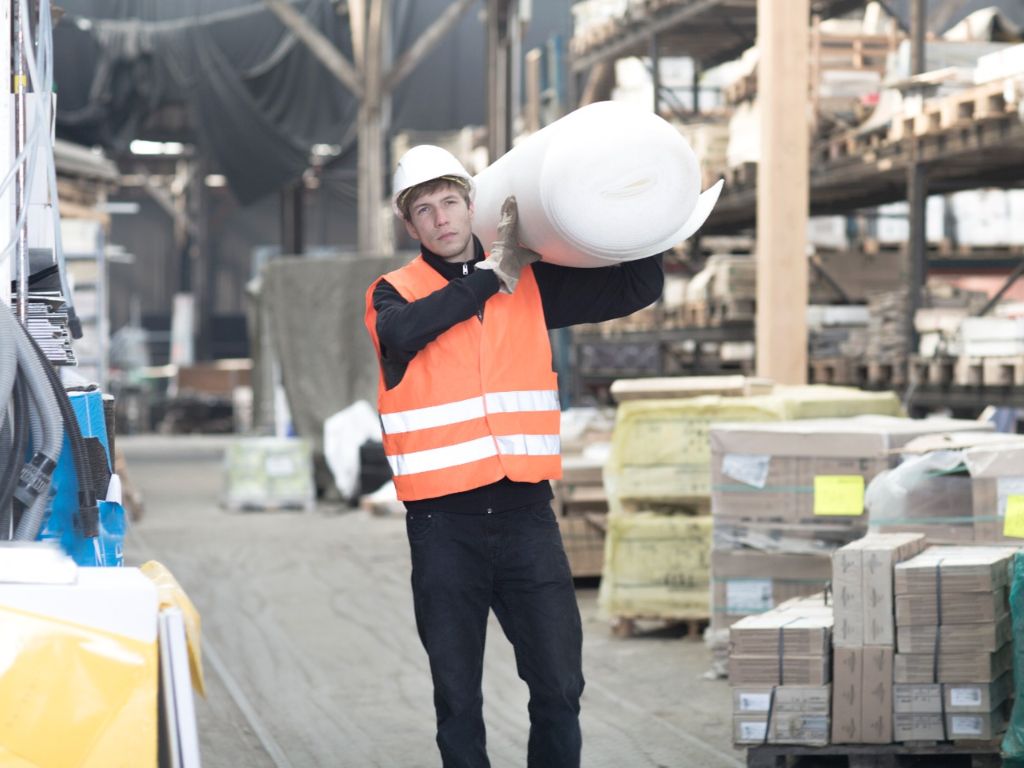
Cement bags. Steel components. Flooring rolls. Panels. Packaged materials. Workers lift, carry, position, and install them hundreds of times a day. Not occasionally — constantly, across every shift.
Most businesses manage this with Safe Work Method Statements. And SWMS documents matter. They set expectations and guide behaviour.
But there is a critical misunderstanding baked into most construction supply operations:
Manual handling procedures in a SWMS are not engineering controls.
This distinction is not technical housekeeping. It directly determines whether your workers get hurt, whether your WorkCover exposure grows, and whether your business is genuinely meeting its WHS obligations — or just documenting that it tried.
Industrial manipulators eliminate repetitive strain at the source
The problem with relying on a SWMS for heavy handling
A SWMS typically includes instructions like:
- Use correct lifting technique
- Team lift for loads above a certain weight
- Rotate workers to reduce fatigue
- Take regular breaks
These are administrative controls. They depend entirely on human behaviour, consistency, and physical capability. And under real operating conditions, those assumptions break down.
Workers get fatigued. Loads are awkward and unpredictable. Repetition compounds the strain. Time pressure creates shortcuts. The best-written procedure in the world cannot override a tired body doing the same motion for the fifth hour straight.
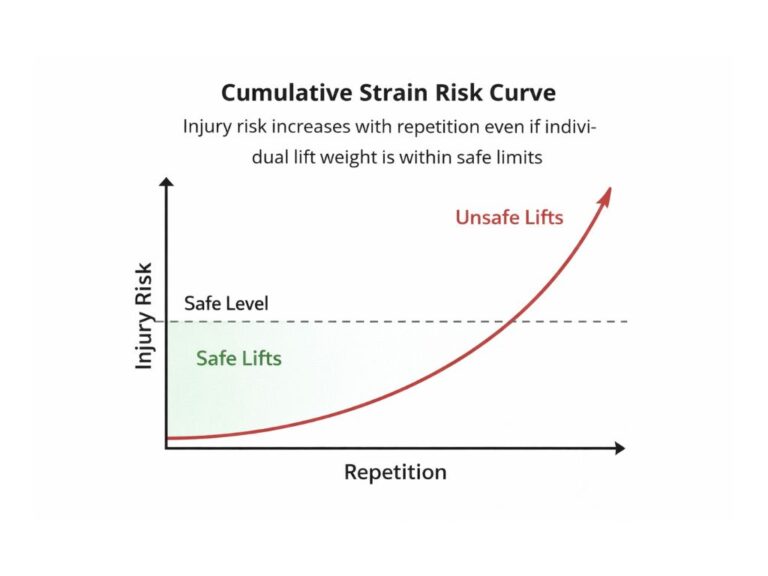
The risk is not the weight. The risk is weight multiplied by frequency multiplied by motion complexity.
A 25kg panel lifted once is manageable. A 25kg panel lifted, rotated, and positioned eighty times per shift is a cumulative injury building quietly across every single cycle — even when every individual lift is technically within the safe limit.
That gap between what the SWMS says and what the body experiences is where injuries happen.
Where the SWMS sits in the hierarchy of controls
Workplace safety in Australia is governed by the hierarchy of controls, which ranks risk mitigation from most to least effective:
- Elimination
- Substitution
- Engineering controls
- Administrative controls — including SWMS procedures and training
- Personal protective equipment
Most construction supply operations sit at level four. Procedures and training.
According to Safe Work Australia, musculoskeletal disorders — the injuries caused by repetitive manual handling — are the single largest category of serious workers compensation claims in Australia. The WHS Act is equally clear: where a risk cannot be eliminated, it must be minimised so far as reasonably practicable. Relying solely on administrative controls when engineering options exist does not meet that standard.
What an engineering control actually is
An engineering control physically changes the way a task is performed. It does not tell workers how to lift more safely. It removes or significantly reduces the need to lift at all.
The shift in thinking is this:
Instead of asking: “How do we train workers to lift this more safely?”
An engineering control asks: “How do we redesign the task so the worker never carries the load?”
That question leads to a different answer entirely.
How Dalmec manipulators are engineered for construction supply tasks
Dalmec as an engineering control
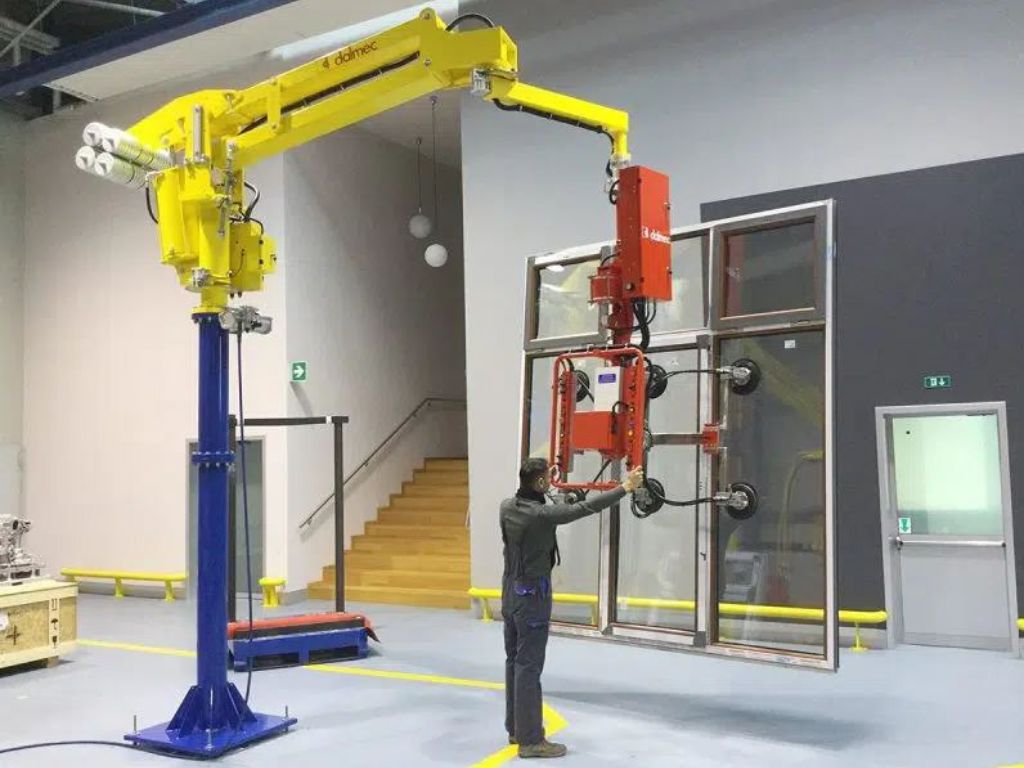
Dalmec industrial manipulators are not lifting aids in the traditional sense. They are custom-engineered systems that carry the full weight of a load — leaving the operator to guide it into position with minimal physical effort.
The operator is no longer lifting. They are guiding.
This is not a subtle difference. It is a fundamental redesign of the task itself.
Dalmec systems are purely pneumatic — no electric motors, no hydraulics, no electronic drive systems. They are custom-engineered for each specific load, motion, and workspace. There is no off-the-shelf unit. Every system is built for the exact task it will perform, every shift, for the life of the installation.
The risk that does not show up until it is too late: cumulative strain
One of the most expensive risks in construction supply is not a single dramatic incident. It is cumulative strain — the kind that builds across weeks and months before anyone calls it an injury.
Even when every individual lift sits within acceptable limits, repetition compounds fatigue, micro-strain accumulates in joints and soft tissue, and injury risk rises gradually and invisibly. This is why so many manual handling injuries happen to experienced workers who have been doing the same task for years without incident.
It is not that the task suddenly became more dangerous. It is that the body quietly ran out of tolerance.
The hierarchy of controls exists precisely because administrative controls cannot fix this. Training tells workers how to manage the exposure. Engineering controls remove the exposure.
Armstrong Flooring: what engineering control looks like in practice
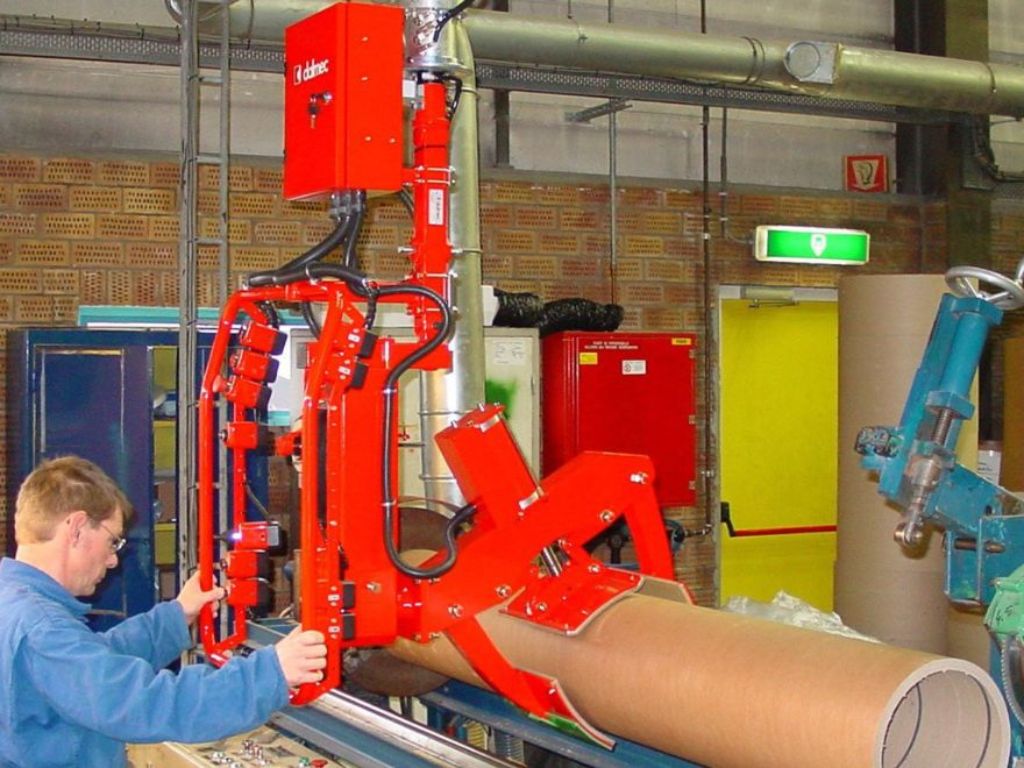
The difference between an administrative control and an engineering control becomes concrete when you look at a real application.
At Armstrong Flooring in Braeside, Victoria, workers were handling 150kg PVC flooring rolls throughout every shift. Each roll needed to be lifted from storage, traversed across the workspace, rotated into position, and placed precisely for the next processing stage. With multiple workers and manual methods, the task introduced significant strain, inconsistency, and injury risk on every cycle.
The engineered solution was a Dalmec industrial manipulator system configured specifically for this task: a 10-metre overhead running rail with a 7-metre working stroke, a motorised trolley for smooth horizontal movement, a custom jaw gripper for PVC rolls, and 90-degree motorised rotation for precise placement. Operated by a single person.
Now, a 150kg roll is gripped, traversed the full 10 metres, rotated 90 degrees, and released precisely by one operator, every cycle, all shift.
Physical strain reduced to near zero. Consistent handling on every cycle. A documented engineering control on record for the WHS file.
That is not a procedure. That is a redesigned task.
How Dalmec manipulators are applied across industrial sectors
Signs your operation needs an engineering control, not another procedure
Construction supply environments combine the conditions that make administrative controls least effective: high volumes, heavy loads, repetitive workflows, and time pressure.
If your operation involves any of the following, it is time to move beyond the SWMS:
- Loads above 20 to 25kg handled repeatedly across a shift
- Awkward or unstable products — rolls, panels, sheets, bags
- Tasks requiring rotation or precise placement
- Two or more people required for a single handling cycle
- Fatigue, strain, or near misses being reported by operators
These are not just safety flags. They are commercial signals that the task is costing more than it appears — in WorkCover exposure, labour dependency, productivity variation, and staff retention.
The commercial case for acting now
A Dalmec system is a capital investment. It is also the correct comparison when the alternative is continuing to absorb the ongoing cost of the problem.
The right financial frame is not ‘can we afford this?’ It is ‘what is this task currently costing us?’
One musculoskeletal injury claim can run to tens of thousands of dollars in direct costs before rehabilitation, lost productivity, and premium impact are counted. A two-person lift requirement ties up a second operator on every cycle across an entire shift. Fatigue-driven inconsistency creates product damage, rework, and quality risk that accumulates invisibly.
A Dalmec system spread across a 15 to 20 year service life is a fraction of those numbers annually. And it eliminates the risk at the source rather than managing it through documentation.
Conclusion
A SWMS is not enough when the task itself is the problem.
Manual handling procedures guide behaviour. They set expectations. But they are administrative controls — and administrative controls do not change what the body experiences on the 80th lift of the shift.
Under the WHS Act, the expectation is clear. Where engineering controls are reasonably practicable, they are the correct response to a manual handling risk. Documenting a procedure is not.
Dalmec industrial manipulators fill that gap. They redesign the task. They remove the physical demand. They turn a procedure into a genuine engineering control — documented, repeatable, and on record.
Send us the load weight, the motion, and how many people it currently takes.